

-
1 one-cycle multivibrator
ждущий мультивибратор
—
[Я.Н.Лугинский, М.С.Фези-Жилинская, Ю.С.Кабиров. Англо-русский словарь по электротехнике и электроэнергетике, Москва, 1999 г.]Тематики
- электротехника, основные понятия
EN
моностабильный элемент
одновибратор
-
[ГОСТ 2.743-91]Одновибраторы -"ждущие мультивибраторы" представляют собой микросхемы, которые в ответ на входной сигнал (логический уровень или фронт) формируют выходной импульс заданной длительности.
Длительность определяется внешними времязадающими резисторами и конденсаторами.
То есть можно считать, что у одновибраторов есть внутренняя память, но эта память хранит информацию о входном сигнале строго заданное время, а потом информация исчезает.
В стандартные серии микросхем входят одновибраторы двух основных типов:
- одновибраторы без перезапуска;
- одновибраторы с перезапуском
Одновибратор без перезапуска не реагирует на входной сигнал до окончания своего выходного импульса.
Одновибратор с перезапуском начинает отсчет нового времени выдержки Т с каждым новым входным сигналом независимо от того, закончилось ли предыдущее время выдержки.
В случае, когда период следования входных сигналов меньше времени выдержки Т, выходной импульс одновибратора сперезапуском не прерывается.
Если период следования входных запускающих импульсов больше времени выдержки одновибратора Т, то оба типа одновибраторов работают одинаково.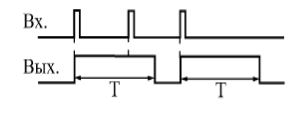
Одновибратор без перезапуска
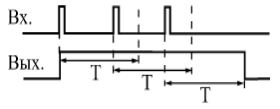
Одновибратор с перезапуском
[Ю.В. Новиков. Введение в цифровую схемотехнику]
Параллельные тексты EN-RU
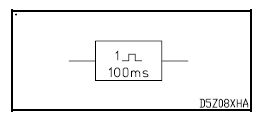
Monostable flip-flop
The output variable will be 1 only if the input variable changes to 1.
The output variable will remain 1 for 100 ms, regardless of the duration of the input value 1 (non-retriggerable).
Without a 1 in the function block, the monostable flip-flop is retriggerable.
The time is 100 ms in this example, but it may be changed to any other duration.
[Schneider Electric]Одновибратор
Значение переменной на выходе равно 1, если входная переменная становится равной 1.
Выходная переменная сохраняет значение 1 в течение 100 мс независимо от времени, в течение которого входная переменная продолжает оставаться равной 1 (без выполнения повторного запуска элемента).
Если в обозначении функции элемента не стоит "1", то это одновибратор с перезапуском.
В данном примере время выходного импульса составляет 100 мс, но его можно изменить на любое другое.
[Перевод Интент]Тематики
- Булева алгебра, элементы цифровой техники
Синонимы
EN
- biased multivibrator
- delay multivibrator
- gate multivibrator
- gated multivibrator
- kipp oscillator
- kipp relay
- latching circuit
- mono
- monoflop
- monostable
- monostable circuit
- monostable flip-flop
- monostable multivibrator
- monostable trigger circuit
- monovibrator
- one-cycle multivibrator
- one-shot
- one-shot generator
- one-shot multivibrator
- single flip-flop oscillator
- single vibrator
- single-shot flip-flop
- single-shot multivibrator
- single-shot trigger
- single-shot trigger circuit
- single-trip multivibrator
- single-trip trigger
- single-trip trigger circuit
- start-stop multivibrator
- trigger circuit
- univibrator
Англо-русский словарь нормативно-технической терминологии > one-cycle multivibrator
-
2 one-shot multivibrator
ждущий мультивибратор
—
[Я.Н.Лугинский, М.С.Фези-Жилинская, Ю.С.Кабиров. Англо-русский словарь по электротехнике и электроэнергетике, Москва, 1999 г.]Тематики
- электротехника, основные понятия
EN
моностабильный элемент
одновибратор
-
[ГОСТ 2.743-91]Одновибраторы -"ждущие мультивибраторы" представляют собой микросхемы, которые в ответ на входной сигнал (логический уровень или фронт) формируют выходной импульс заданной длительности.
Длительность определяется внешними времязадающими резисторами и конденсаторами.
То есть можно считать, что у одновибраторов есть внутренняя память, но эта память хранит информацию о входном сигнале строго заданное время, а потом информация исчезает.
В стандартные серии микросхем входят одновибраторы двух основных типов:
- одновибраторы без перезапуска;
- одновибраторы с перезапуском
Одновибратор без перезапуска не реагирует на входной сигнал до окончания своего выходного импульса.
Одновибратор с перезапуском начинает отсчет нового времени выдержки Т с каждым новым входным сигналом независимо от того, закончилось ли предыдущее время выдержки.
В случае, когда период следования входных сигналов меньше времени выдержки Т, выходной импульс одновибратора сперезапуском не прерывается.
Если период следования входных запускающих импульсов больше времени выдержки одновибратора Т, то оба типа одновибраторов работают одинаково.
Одновибратор без перезапуска
Одновибратор с перезапуском
[Ю.В. Новиков. Введение в цифровую схемотехнику]
Параллельные тексты EN-RU
Monostable flip-flop
The output variable will be 1 only if the input variable changes to 1.
The output variable will remain 1 for 100 ms, regardless of the duration of the input value 1 (non-retriggerable).
Without a 1 in the function block, the monostable flip-flop is retriggerable.
The time is 100 ms in this example, but it may be changed to any other duration.
[Schneider Electric]Одновибратор
Значение переменной на выходе равно 1, если входная переменная становится равной 1.
Выходная переменная сохраняет значение 1 в течение 100 мс независимо от времени, в течение которого входная переменная продолжает оставаться равной 1 (без выполнения повторного запуска элемента).
Если в обозначении функции элемента не стоит "1", то это одновибратор с перезапуском.
В данном примере время выходного импульса составляет 100 мс, но его можно изменить на любое другое.
[Перевод Интент]Тематики
- Булева алгебра, элементы цифровой техники
Синонимы
EN
- biased multivibrator
- delay multivibrator
- gate multivibrator
- gated multivibrator
- kipp oscillator
- kipp relay
- latching circuit
- mono
- monoflop
- monostable
- monostable circuit
- monostable flip-flop
- monostable multivibrator
- monostable trigger circuit
- monovibrator
- one-cycle multivibrator
- one-shot
- one-shot generator
- one-shot multivibrator
- single flip-flop oscillator
- single vibrator
- single-shot flip-flop
- single-shot multivibrator
- single-shot trigger
- single-shot trigger circuit
- single-trip multivibrator
- single-trip trigger
- single-trip trigger circuit
- start-stop multivibrator
- trigger circuit
- univibrator
Англо-русский словарь нормативно-технической терминологии > one-shot multivibrator
-
3 one-shot
моностабильный элемент
одновибратор
-
[ГОСТ 2.743-91]Одновибраторы -"ждущие мультивибраторы" представляют собой микросхемы, которые в ответ на входной сигнал (логический уровень или фронт) формируют выходной импульс заданной длительности.
Длительность определяется внешними времязадающими резисторами и конденсаторами.
То есть можно считать, что у одновибраторов есть внутренняя память, но эта память хранит информацию о входном сигнале строго заданное время, а потом информация исчезает.
В стандартные серии микросхем входят одновибраторы двух основных типов:
- одновибраторы без перезапуска;
- одновибраторы с перезапуском
Одновибратор без перезапуска не реагирует на входной сигнал до окончания своего выходного импульса.
Одновибратор с перезапуском начинает отсчет нового времени выдержки Т с каждым новым входным сигналом независимо от того, закончилось ли предыдущее время выдержки.
В случае, когда период следования входных сигналов меньше времени выдержки Т, выходной импульс одновибратора сперезапуском не прерывается.
Если период следования входных запускающих импульсов больше времени выдержки одновибратора Т, то оба типа одновибраторов работают одинаково.
Одновибратор без перезапуска
Одновибратор с перезапуском
[Ю.В. Новиков. Введение в цифровую схемотехнику]
Параллельные тексты EN-RU
Monostable flip-flop
The output variable will be 1 only if the input variable changes to 1.
The output variable will remain 1 for 100 ms, regardless of the duration of the input value 1 (non-retriggerable).
Without a 1 in the function block, the monostable flip-flop is retriggerable.
The time is 100 ms in this example, but it may be changed to any other duration.
[Schneider Electric]Одновибратор
Значение переменной на выходе равно 1, если входная переменная становится равной 1.
Выходная переменная сохраняет значение 1 в течение 100 мс независимо от времени, в течение которого входная переменная продолжает оставаться равной 1 (без выполнения повторного запуска элемента).
Если в обозначении функции элемента не стоит "1", то это одновибратор с перезапуском.
В данном примере время выходного импульса составляет 100 мс, но его можно изменить на любое другое.
[Перевод Интент]Тематики
- Булева алгебра, элементы цифровой техники
Синонимы
EN
- biased multivibrator
- delay multivibrator
- gate multivibrator
- gated multivibrator
- kipp oscillator
- kipp relay
- latching circuit
- mono
- monoflop
- monostable
- monostable circuit
- monostable flip-flop
- monostable multivibrator
- monostable trigger circuit
- monovibrator
- one-cycle multivibrator
- one-shot
- one-shot generator
- one-shot multivibrator
- single flip-flop oscillator
- single vibrator
- single-shot flip-flop
- single-shot multivibrator
- single-shot trigger
- single-shot trigger circuit
- single-trip multivibrator
- single-trip trigger
- single-trip trigger circuit
- start-stop multivibrator
- trigger circuit
- univibrator
однотактный
—
[ http://www.iks-media.ru/glossary/index.html?glossid=2400324]Тематики
- электросвязь, основные понятия
EN
одношаговый
однократный
—
[Л.Г.Суменко. Англо-русский словарь по информационным технологиям. М.: ГП ЦНИИС, 2003.]Тематики
Синонимы
EN
Англо-русский словарь нормативно-технической терминологии > one-shot
-
4 one-shot generator
моностабильный элемент
одновибратор
-
[ГОСТ 2.743-91]Одновибраторы -"ждущие мультивибраторы" представляют собой микросхемы, которые в ответ на входной сигнал (логический уровень или фронт) формируют выходной импульс заданной длительности.
Длительность определяется внешними времязадающими резисторами и конденсаторами.
То есть можно считать, что у одновибраторов есть внутренняя память, но эта память хранит информацию о входном сигнале строго заданное время, а потом информация исчезает.
В стандартные серии микросхем входят одновибраторы двух основных типов:
- одновибраторы без перезапуска;
- одновибраторы с перезапуском
Одновибратор без перезапуска не реагирует на входной сигнал до окончания своего выходного импульса.
Одновибратор с перезапуском начинает отсчет нового времени выдержки Т с каждым новым входным сигналом независимо от того, закончилось ли предыдущее время выдержки.
В случае, когда период следования входных сигналов меньше времени выдержки Т, выходной импульс одновибратора сперезапуском не прерывается.
Если период следования входных запускающих импульсов больше времени выдержки одновибратора Т, то оба типа одновибраторов работают одинаково.
Одновибратор без перезапуска
Одновибратор с перезапуском
[Ю.В. Новиков. Введение в цифровую схемотехнику]
Параллельные тексты EN-RU
Monostable flip-flop
The output variable will be 1 only if the input variable changes to 1.
The output variable will remain 1 for 100 ms, regardless of the duration of the input value 1 (non-retriggerable).
Without a 1 in the function block, the monostable flip-flop is retriggerable.
The time is 100 ms in this example, but it may be changed to any other duration.
[Schneider Electric]Одновибратор
Значение переменной на выходе равно 1, если входная переменная становится равной 1.
Выходная переменная сохраняет значение 1 в течение 100 мс независимо от времени, в течение которого входная переменная продолжает оставаться равной 1 (без выполнения повторного запуска элемента).
Если в обозначении функции элемента не стоит "1", то это одновибратор с перезапуском.
В данном примере время выходного импульса составляет 100 мс, но его можно изменить на любое другое.
[Перевод Интент]Тематики
- Булева алгебра, элементы цифровой техники
Синонимы
EN
- biased multivibrator
- delay multivibrator
- gate multivibrator
- gated multivibrator
- kipp oscillator
- kipp relay
- latching circuit
- mono
- monoflop
- monostable
- monostable circuit
- monostable flip-flop
- monostable multivibrator
- monostable trigger circuit
- monovibrator
- one-cycle multivibrator
- one-shot
- one-shot generator
- one-shot multivibrator
- single flip-flop oscillator
- single vibrator
- single-shot flip-flop
- single-shot multivibrator
- single-shot trigger
- single-shot trigger circuit
- single-trip multivibrator
- single-trip trigger
- single-trip trigger circuit
- start-stop multivibrator
- trigger circuit
- univibrator
Англо-русский словарь нормативно-технической терминологии > one-shot generator
-
5 need plus one
- принцип резервирования N+1
принцип резервирования N+1
Системы бесперебойного электроитания (СБЭ), использующие принцип резервирования N+1, представляют собой системы с так называемым "горячим" (т. е. находящимся под нагрузкой) резервом.
[А. Воробьев. Классификация ИБП http://www.osp.ru/lan/2003/10/138056/ с изменениями]EN
N+1 redundancy
A redundant method based on one module more than needed to fulfill the required performance. For instance, three parallel systems, each rated 2KVA, form a 2+1 redundant system for a 4KVA consumer. Failure of a single UPS will not affect systems operational performance.
[ http://www.upsonnet.com/UPS-Glossary/]Параллельные тексты EN-RU
N+X redundancy
Load remains secure in the event of a module failure.
One Ensuring a high level of availability while reducing the initial investment.
(N+1) or more (N+X) redundant modules could be added to the system
[GUTOR Electronic LLC]Резервирование по принципу N+X
Электропитание нагрузки в случае выхода модуля из строя не прерывается.
Обеспечивается высокий уровень эксплуатационной готовности при сокращении первоначальных затрат.
В системе может быть один (резервирование по принципу N+1) или Х (резервирование по принципу N+X) резервных модулей.
[Перевод Интент]N + 1 Redundancy ensures maximum uptime and continuous availability
Резервирование по принципу N + 1 минимизирует время простоя и обеспечивает постоянную готовность оборудования
Symmetra Power Array achieves N+1 redundancy and higher through proven power sharing technology.
Power sharing means that all of the power modules in a Power Array run in parallel and share the load evenly.
N+1 redundancy means running one extra module than will support your full load.
В ИБП семейства Symmetra Power Аггау резервирование по принципу N+1 или с более высокой избыточностью реализуется на основе проверенной практикой технологии распределения нагрузки.
Все модули электропитания работают параллельно и несут одинаковую нагрузку.
Резервирование по принципу N+1 означает, что число модулей электропитания превышает на 1 необходимое для питания защищаемых устройств при их работе на максимальную мощность.In this way, all of the modules support one another.
Таким образом, каждый модуль подстраховывает другие модули
For example, if your computer load is 15kVA, you achieve N+1 with five 4kVA Power Modules.
Например, если максимальная потребляемая мощность компьютерной системы составляет 15 кВА, то для резервирования по принципу N+1 требуется пять модулей электропитания по 4 кВА каждый.
If a module fails or is removed, the other modules instantaneously begin supporting the full load.
It does not matter which module fails because all of the modules are always running and supporting your load.В случае аварии или отключения одного из модулей нагрузка мгновенно перераспределяется на остальные модули.
Не имеет значения, какой именно из модулей прекратит работу - каждый одновременно выполняет функции и основного и резервного.Тематики
EN
- N+1
- N+1 configurability
- N+1 redundancy
- need plus one
Англо-русский словарь нормативно-технической терминологии > need plus one
-
6 no
nəu
1. нареч.
1) нет no, I don't want ≈ нет, не хочу
2) не no less than whether or no
3) усил. перед not, nor усиливает отрицание He never stirred from his ground;
no, not an inch. ≈ Он никогда не покидал своей земли, не сдвигался даже на дюйм.
2. мест.;
отр.
1) никакой, нет he has no children ≈ у него нет детей
2) (совсем) не
3) очень мало;
почти не
4) означает запрещение, отсутствие
5) с отглагольным существительным или герундием означает невозможность ∙ no cross, no crown посл. ≈ без труда нет плода;
горя бояться, счастья не видать no matter ≈ безразлично, неважно no odds ≈ неважно, не имеет значения no man's land
3. сущ.
1) отрицание
2) отказ, отклонение
3) мн. голосующие против отрицание, нет - two noes makes a yes два отрицания равны утверждению отказ - he will not take no for an answer он не примет отказа pl голоса против - the noes have it большинство против никакой;
нет - he has no money у него нет денег - there will be no difficulty никаких трудностей не будет никакой, ни один - no man никто, ни один человек - no man alive никто на свете - no sensible man would say that ни один разумный человек этого не скажет - no one example will suffice никакой отдельно взятый пример сам по себе не убедителен - no one man ни один человек, взятый отдельно - no one man can do this в одиночку это никому не под силу - no two men think alike нет двух людей, мыслящих одинаково, каждый мыслит по-своему - no two ways about it не может быть двух мнений насчет этого;
другого выхода нет (совсем) не - a question of no great importance вопрос, не имеющий особого значения - he is no fool он (вовсе) не дурак, он совсем не глуп - a teacher of no mean ability талантливый преподаватель - to the no small admiration of the learned readers к немалому восторгу просвещенных читателей - he showed no great skill он не проявил большой ловкости - I have no great regard for him особого уважения он у меня не вызывает - he expressed his opinion in no uncertain terms он недвусмысленно высказал свое мнение - he had no small part in the plan's success он сыграл немаловажную роль в успехе этого плана почти не;
очень мало - in no time очень быстро;
в два счета - we finished the work in no time мы не успели оглянуться, как работа была закончена - it's no distance to the post office до почты рукой подать перед названиями профессий, занятий означает несоответствие: - she is no teacher она плохой педагог;
никакой она не педагог - I am no philosopher я не философ;
какой из меня философ;
я не претендую на то, чтобы меня считали философом означает запрещение и т. п.: - No smoking! курить воспрещается! - No parking! Стоянка запрещена - No road проезда нет (дорожный знак) - no trumps! (карточное) без козыря! - no comment мне нечего сказать (формула отказа в интервью) - no opinion воздерживаюсь - no place no date (полиграфия) без указания места и даты (издания) с отглагольным существительным или герундием означает невозможность совершения выраженного ими действия: - there is no getting away from the fact от этого факта не уйти, нельзя закрывать глаза на этот факт - there is no knowing what may happen нельзя знать, что может случиться в сочетаниях: - no other никто иной - no other than никто иной как - no doubt конечно, несомненно - no wonder неудивительно;
ничего удивительного, что - no hurry не к спеху - by no means никоим образом - no fear( разговорное) конечно, нет;
(этого) опасаться не приходиться;
ни в коем случае > no end of smth. очень много чего-л. > we had no end of a good time мы очень веселились, мы отлично провели время > no go тупиковая ситуация;
отсутствие месячных не;
нисколько не - no longer уже не;
больше не - he is no longer in Washington в Вашингтоне его уже нет - I can wait no longer я не могу дольше ждать - no more нечего, ничего больше;
больше нет;
уже нет;
тоже нет - he is no more (возвышенно) его больше нет, он умер - I have no more to say мне больше нечего сказать - no more tea, thank you я больше не хочу чаю, спасибо - no more trifling! довольно шутить! - after this accident he will walk no more после этого несчастного случая он больше не будет ходить /он уже не встанет/ - he is no more able to do it than I am он так же мало способен сделать это, как и я - I can no more sing than play я не только не играю, но и не пою - if you won't go, no more will I если вы не пойдете, то и я не пойду - I went no further than the station дальше станции я не пошел - he is no better yet ему пока( нисколько) не лучше - there were no fewer than fifty people there там было не менее пятидесяти человек - I am glad it is no worse( разговорное) рад, что хуже не вышло > no can do этого я не могу, это невозможно нет - no, thank you нет, спасибо - have you seen him? - No! вы видели его? - Нет! перед not или nor выражает усиление отрицания: - I haven't found better hotels anywhere, no, not even in Switzerland нигде, даже в Швейцарии, я не видел гостиниц лучше - one man could not lift it, no, not half a dozen один человек не мог это поднять, да и шестеро не подняли бы - who spoke no slander, no, nor listened to it! кто не клеветал или не слушал никогда клеветников! в предложениях, содержащий альтернативу: нет - pleasant or no, it is true приятно это или нет, но это правда - whether or no в любом случае;
так или иначе - you may not like it, but you'll have to do it, whether or no вам, возможно, это не нравится, но так или иначе вам придется это сделать - I am uncertain whether or no to notice some of his previous exploits я не могу решить, обращать или не обращать внимание на некоторые его прежние похождения в грам. знач. междометия означает удивление, возмущение: - he threatened to strike me. - No! он грозился ударить меня. - Не может быть! /Что вы говорите!/ (сокр. от number) номер he is ~ more его нет в живых, он умер;
he cannot come, no more can I он не может прийти, как и я ~ pron neg. никакой (= not any;
перед существительным передается обыкн. словом нет) ;
he has no reason to be offended у него нет (никакой) причины обижаться he is ~ better today сегодня ему (нисколько) не лучше;
I can wait no longer я не могу дольше ждать ~ pron neg. не (= not a) ;
he is no fool он неглуп, он не дурак;
no such thing ничего подобного;
no doubt несомненно;
no wonder неудивительно ~ отказ;
he will not take no for an answer он не примет отказа he is ~ better today сегодня ему (нисколько) не лучше;
I can wait no longer я не могу дольше ждать ~ less than ни больше, ни меньше как;
no more нечего, ничего больше;
нет (больше) ;
I have no more to say мне нечего больше сказать ~ matter безразлично, неважно;
no odds неважно, не имеет значения;
in no time очень быстро, в мгновение ока time: in no ~ необыкновенно быстро, моментально;
before time слишком рано ~ compromise! никаких компромиссов!;
no special invitations особых приглашений не будет;
no trumps! без козыря! ~ cross, ~ crown посл. = без труда нет плода;
горя бояться, счастья не видать;
no flies on him его не проведешь;
no man никто ~ cross, ~ crown посл. = без труда нет плода;
горя бояться, счастья не видать;
no flies on him его не проведешь;
no man никто ~ cross, ~ crown посл. = без труда нет плода;
горя бояться, счастья не видать;
no flies on him его не проведешь;
no man никто ~ less than не менее, чем ~ less than ни больше, ни меньше как;
no more нечего, ничего больше;
нет (больше) ;
I have no more to say мне нечего больше сказать ~ cross, ~ crown посл. = без труда нет плода;
горя бояться, счастья не видать;
no flies on him его не проведешь;
no man никто ~ man's land ист. бесхозная земля ~ man's land воен. "ничья земля", пространство между траншеями противников ~ less than ни больше, ни меньше как;
no more нечего, ничего больше;
нет (больше) ;
I have no more to say мне нечего больше сказать he is ~ more его нет в живых, он умер;
he cannot come, no more can I он не может прийти, как и я ~ matter безразлично, неважно;
no odds неважно, не имеет значения;
in no time очень быстро, в мгновение ока ~ pron neg. означает запрещение, отсутствие;
no smoking! курить воспрещается! ~ sooner had he arrived than he fell ill едва он успел приехать, как заболел ~ compromise! никаких компромиссов!;
no special invitations особых приглашений не будет;
no trumps! без козыря! ~ pron neg. не (= not a) ;
he is no fool он неглуп, он не дурак;
no such thing ничего подобного;
no doubt несомненно;
no wonder неудивительно ~ compromise! никаких компромиссов!;
no special invitations особых приглашений не будет;
no trumps! без козыря! ~ two ways about it другого выхода нет ~ two ways about it не может быть двух мнений насчет этого;
by no means никоим образом;
конечно, нет way: no two ways about it об этом не может быть двух мнений;
to put (smb.) in the way (of smth.) предоставить( кому-л.) случай, дать возможность( сделать что-л.) no two ways about it это неизбежно ~ pron neg. не (= not a) ;
he is no fool он неглуп, он не дурак;
no such thing ничего подобного;
no doubt несомненно;
no wonder неудивительно wonder: ~ удивление, изумление;
(it is) no wonder (that) неудивительно (, что) ;
what a wonder! поразительно! ~ голосующие против;
the noes have it большинство против there is ~ telling what he is up to никогда не знаешь, что он замышляет ~ pron neg. с отглагольным существительным или герундием означает невозможность: there's no knowing what may happen нельзя знать, что может случиться ~ (pl noes) отрицание;
two noes make a yes два отрицания равны утверждению ~ end of очень много, множество;
we had no end of good time мы превосходно провели время -
7 historic
•• historic, historical, historically
•• * Существование в английском языке двух слов – historic и historical – имеет два противоречащих друг другу следствия. Во-первых, в устной речи нередко смешение этих слов. Мне приходилось слышать, как о событии, еще не «ушедшем в историю» и даже еще не состоявшемся, говорили It is/ will be a/ an historical event. Конечно, правильнее в данном случае historic или history-making. Но и historical event тоже правильно в определенных контекстах:
•• What historical event do you wish you could stop? If you could go back in time and prevent anything in history from having happened ( as opposed to just passively watching it happen), what particular incident in history would you most want to stop from happening and is there any reason why? (c сайта http://uplink.space.com).
•• С другой стороны, иногда различие между этими словами существенно и должно учитываться переводчиком. Слово historical, как мне кажется, шире русского исторический, так как охватывает все, что имеет отношение к прошлому, а русское слово – только то, что говорящий интуитивно относит к «истории», т.е. к историческому процессу, «историческим судьбам» и т.п. Русское слово часто, хотя и не всегда, «возвышенней». Среди исключений – например, словосочетание историческая справка. И все же более «бытовой» характер английского слова позволяет употреблять его в тех ситуациях, где говорящий по-русски скорее всего скажет иначе.
•• В выступлении Кондолисы Райс перед комиссией по расследованию событий 11 сентября это слово встретилось пять раз, плюс historically в значении, о котором будет сказано ниже:
•• Historically, democratic societies have been slow to react to gathering threats, tending instead to wait to confront threats until they are too dangerous to ignore or until it is too late. – Исторический опыт (или просто опыт) свидетельствует о том, что...
•• Далее Райс трижды употребляет это слово в отношении документа, представленного президенту Бушу 6 августа 2001 года (о возможных действиях «Аль-Каиды»):
•• I was in a press conference to try and describe the Aug. 6 memo, which I’ve talked about here in the – my opening remarks and which I talked about with you in the private session. And I said at one point that this was a historical memo, that it was not based on new threat information. <...>
•• It was not a particular threat report. And there was historical information in there about – about various aspects of al Qaeda’s operations. <...> It did not warn of attacks inside the United States. It was historical information based on old reporting. There was no new threat information. And it did not, in fact, warn of any coming attacks inside the United States.
•• Один из членов комиссии (демократ) ухватился за эту формулировку:
•• Well, did you not – you have indicated here that this was some historical document. And I am asking you whether it is not the case that you learned in the P.D.B. memo of Aug. 6 that the F.B.I. was saying that it had information suggesting that preparations, not historically, but ongoing, along with these numerous full field investigations against al Qaeda cells, that preparations were being made consistent with hijackings within the United States.
•• Конечно, по-русски в данном случае просто невозможно сказать исторический документ, хотя можно – историческая справка, но предпочтительно все же, по-моему, справочный материал, справочная информация. В вопросе – not historically, but ongoing – возможен вариант не в историческом разрезе, а в текущем плане.
•• Далее у Райс интересная оговорка, тут же исправленная:
•• This was a historic memo – historical memo prepared by the agency because the president was asking questions about what we knew about the inside.
•• Исправление оговорки – признак существенного различия двух слов. (Кстати, в качестве антонима historical появляется слово, неоднократно всплывавшее в ходе слушаний и не поддающееся однословному переводу, – actionable:
•• The president was told this is historical information. I am told he was told this is historical information. And there was nothing actionable in this. The president knew that the F.B.I. was pursuing this issue. The president knew that the director of central intelligence was pursuing this issue. And there was no new threat information in this document to pursue.
•• Actionable information – пока не могу предложить ничего кроме информация, требующая/ дающая основания для конкретных действий. Длинно.)
•• Конечно, «оппозиция Его Величества» не замедлила поиграть со словом historical. Из редакционной статьи New York Times:
•• The administration argument that it had only gotten intelligence about potential terrorist attacks abroad in the summer of 2001 was rather drastically undermined when Ms. Rice revealed, under questioning, that the briefing given Mr. Bush by the C.I.A. on Aug. 6, 2001, was titled “Bin Laden Determined to Attack Inside the United States.” Ms. Rice continues to insist that the information was “ historical” rather than a warning of something likely to occur.
•• Еще более хлестко (но абсолютно неизбежно, удержаться от игры слов невозможно):
•• What should have made Condi hysterical, she deemed “historical.” (Maureen Dowd)
•• Последний пример, кстати, заставляет все-таки выбрать в переводе вариант историческая справка, чтобы попробовать передать игру слов, но все равно сделать это непросто:
•• Информация, способная вызвать истерическую реакцию, для Конди – не более чем историческая справка.
•• А теперь о наречии historically. Словари – как толковые, так и переводные, – как правило, не дают отдельного определения или перевода наречий с - ly, считая, что все и так ясно – их смысл и перевод вытекают из соответствующего прилагательного. Но это далеко не всегда так. В статье из New York Times, попавшей в обзор зарубежной прессы на радио «Эхо Москвы», встретилось: Iran has historically denied that it is pursuing a nuclear weapons program. Ведущая так и сказала: Иран исторически отрицал (и т.д.). Здесь, конечно, нужно просто всегда или неизменно. В некоторых случаях хорошо подойдет русское наречие традиционно: historically black colleges – традиционно негритянские колледжи (здесь это прилагательное, по-моему, вполне приемлемо), historically underutilized businesses – компании, традиционно недопредставленные среди подрядчиков, historically disadvantaged – традиционно находящиеся в тяжелом положении. Иногда подходящее русское соответствие – по многолетним наблюдениям ( This is not uncommon historically for the month of April). Наконец, контекст может подсказать и такой вариант, как беспрецедентно: Historically high growth in employment.
•• Интересный пример из статьи У. Пфаффа в International Herald Tribune:
•• Historically, in joint ventures with U.S. government and industry, U.S. security and proprietary restraints nearly always have forced the European partners into subordinate roles.
•• Здесь самый лучший перевод – просто раньше, прежде.
•• Слово historically, на мой взгляд, не является многозначным, у него одно довольно широкое и несколько расплывчатое значение, но в переводе оно начинает играть своими различными гранями. Разумеется, в приведенном выше примере возможен и перевод Исторически сложилось так, что...
•• В отличие от historically наречие indefinitely дается в большинстве словарей (например, в БАРСе и ABBYY Lingvo) как отдельная словарная статья. Но упущено довольно частое употребление indefinitely в значении, близком к until further notice. Пример из New York Times:
•• Thomas Krens, the foundation director, acknowledged as unrealistic the prospect of financing the $950 million project at a time when the museum is cutting budget, staff and programs. Beginning Sunday, for example, the Guggenheim Las Vegas is to go dark indefinitely.
•• Перевод напрашивается: на неопределенный срок. Кстати, to go dark – есть ли это в словарях? Обычно так говорят, когда, скажем, музей, театр или web-сайт прерывают работу на некоторое время – с возможностью ее возобновления.
•• Еще один пример интересного с точки зрения перевода и лексикографии употребления наречия (для контекста даю несколько предшествующих фраз):
•• After months of inaction, I finally turned to former President Bush, who immediately interceded with Crown Prince Abdallah on the FBI’s behalf. <...> The Saudis immediately acceded. <...> Mr. Bush typically disclaimed any credit for his critical intervention, but he earned the gratitude of many FBI agents and the Khobar families. (American Justice for Khobar Heroes. By Louis J. Freeh. Wall Street Journal)
•• Typically здесь нельзя переводить как типично или даже что для него типично. В каких-то случаях может подойти разговорное что характерно. Но лучше, конечно, в свойственной ему манере или как обычно. Думаю, в двуязычном словаре для такого примера должно найтись место. Во-первых, он показывает идиоматичное употребление английского наречия. Во-вторых, подсказывает перевод.
•• Наречия типа confusingly обычно не включаются в словари в качестве отдельной статьи. Считается, что перевод таких слов, как amazingly или startlingly, не должен вызывать трудностей, но это не всегда так. На конференции по товарным знакам встретилось выражение confusingly similar. В юридическом словаре есть confusion in trademarks – смешение товарных знаков. Соответственно confusingly similar – схожий/ аналогичный до степени смешения (принятый практиками перевод). Пожалуй, это стоит включить не только в специальный словарь.
-
8 historical
•• historic, historical, historically
•• * Существование в английском языке двух слов – historic и historical – имеет два противоречащих друг другу следствия. Во-первых, в устной речи нередко смешение этих слов. Мне приходилось слышать, как о событии, еще не «ушедшем в историю» и даже еще не состоявшемся, говорили It is/ will be a/ an historical event. Конечно, правильнее в данном случае historic или history-making. Но и historical event тоже правильно в определенных контекстах:
•• What historical event do you wish you could stop? If you could go back in time and prevent anything in history from having happened ( as opposed to just passively watching it happen), what particular incident in history would you most want to stop from happening and is there any reason why? (c сайта http://uplink.space.com).
•• С другой стороны, иногда различие между этими словами существенно и должно учитываться переводчиком. Слово historical, как мне кажется, шире русского исторический, так как охватывает все, что имеет отношение к прошлому, а русское слово – только то, что говорящий интуитивно относит к «истории», т.е. к историческому процессу, «историческим судьбам» и т.п. Русское слово часто, хотя и не всегда, «возвышенней». Среди исключений – например, словосочетание историческая справка. И все же более «бытовой» характер английского слова позволяет употреблять его в тех ситуациях, где говорящий по-русски скорее всего скажет иначе.
•• В выступлении Кондолисы Райс перед комиссией по расследованию событий 11 сентября это слово встретилось пять раз, плюс historically в значении, о котором будет сказано ниже:
•• Historically, democratic societies have been slow to react to gathering threats, tending instead to wait to confront threats until they are too dangerous to ignore or until it is too late. – Исторический опыт (или просто опыт) свидетельствует о том, что...
•• Далее Райс трижды употребляет это слово в отношении документа, представленного президенту Бушу 6 августа 2001 года (о возможных действиях «Аль-Каиды»):
•• I was in a press conference to try and describe the Aug. 6 memo, which I’ve talked about here in the – my opening remarks and which I talked about with you in the private session. And I said at one point that this was a historical memo, that it was not based on new threat information. <...>
•• It was not a particular threat report. And there was historical information in there about – about various aspects of al Qaeda’s operations. <...> It did not warn of attacks inside the United States. It was historical information based on old reporting. There was no new threat information. And it did not, in fact, warn of any coming attacks inside the United States.
•• Один из членов комиссии (демократ) ухватился за эту формулировку:
•• Well, did you not – you have indicated here that this was some historical document. And I am asking you whether it is not the case that you learned in the P.D.B. memo of Aug. 6 that the F.B.I. was saying that it had information suggesting that preparations, not historically, but ongoing, along with these numerous full field investigations against al Qaeda cells, that preparations were being made consistent with hijackings within the United States.
•• Конечно, по-русски в данном случае просто невозможно сказать исторический документ, хотя можно – историческая справка, но предпочтительно все же, по-моему, справочный материал, справочная информация. В вопросе – not historically, but ongoing – возможен вариант не в историческом разрезе, а в текущем плане.
•• Далее у Райс интересная оговорка, тут же исправленная:
•• This was a historic memo – historical memo prepared by the agency because the president was asking questions about what we knew about the inside.
•• Исправление оговорки – признак существенного различия двух слов. (Кстати, в качестве антонима historical появляется слово, неоднократно всплывавшее в ходе слушаний и не поддающееся однословному переводу, – actionable:
•• The president was told this is historical information. I am told he was told this is historical information. And there was nothing actionable in this. The president knew that the F.B.I. was pursuing this issue. The president knew that the director of central intelligence was pursuing this issue. And there was no new threat information in this document to pursue.
•• Actionable information – пока не могу предложить ничего кроме информация, требующая/ дающая основания для конкретных действий. Длинно.)
•• Конечно, «оппозиция Его Величества» не замедлила поиграть со словом historical. Из редакционной статьи New York Times:
•• The administration argument that it had only gotten intelligence about potential terrorist attacks abroad in the summer of 2001 was rather drastically undermined when Ms. Rice revealed, under questioning, that the briefing given Mr. Bush by the C.I.A. on Aug. 6, 2001, was titled “Bin Laden Determined to Attack Inside the United States.” Ms. Rice continues to insist that the information was “ historical” rather than a warning of something likely to occur.
•• Еще более хлестко (но абсолютно неизбежно, удержаться от игры слов невозможно):
•• What should have made Condi hysterical, she deemed “historical.” (Maureen Dowd)
•• Последний пример, кстати, заставляет все-таки выбрать в переводе вариант историческая справка, чтобы попробовать передать игру слов, но все равно сделать это непросто:
•• Информация, способная вызвать истерическую реакцию, для Конди – не более чем историческая справка.
•• А теперь о наречии historically. Словари – как толковые, так и переводные, – как правило, не дают отдельного определения или перевода наречий с - ly, считая, что все и так ясно – их смысл и перевод вытекают из соответствующего прилагательного. Но это далеко не всегда так. В статье из New York Times, попавшей в обзор зарубежной прессы на радио «Эхо Москвы», встретилось: Iran has historically denied that it is pursuing a nuclear weapons program. Ведущая так и сказала: Иран исторически отрицал (и т.д.). Здесь, конечно, нужно просто всегда или неизменно. В некоторых случаях хорошо подойдет русское наречие традиционно: historically black colleges – традиционно негритянские колледжи (здесь это прилагательное, по-моему, вполне приемлемо), historically underutilized businesses – компании, традиционно недопредставленные среди подрядчиков, historically disadvantaged – традиционно находящиеся в тяжелом положении. Иногда подходящее русское соответствие – по многолетним наблюдениям ( This is not uncommon historically for the month of April). Наконец, контекст может подсказать и такой вариант, как беспрецедентно: Historically high growth in employment.
•• Интересный пример из статьи У. Пфаффа в International Herald Tribune:
•• Historically, in joint ventures with U.S. government and industry, U.S. security and proprietary restraints nearly always have forced the European partners into subordinate roles.
•• Здесь самый лучший перевод – просто раньше, прежде.
•• Слово historically, на мой взгляд, не является многозначным, у него одно довольно широкое и несколько расплывчатое значение, но в переводе оно начинает играть своими различными гранями. Разумеется, в приведенном выше примере возможен и перевод Исторически сложилось так, что...
•• В отличие от historically наречие indefinitely дается в большинстве словарей (например, в БАРСе и ABBYY Lingvo) как отдельная словарная статья. Но упущено довольно частое употребление indefinitely в значении, близком к until further notice. Пример из New York Times:
•• Thomas Krens, the foundation director, acknowledged as unrealistic the prospect of financing the $950 million project at a time when the museum is cutting budget, staff and programs. Beginning Sunday, for example, the Guggenheim Las Vegas is to go dark indefinitely.
•• Перевод напрашивается: на неопределенный срок. Кстати, to go dark – есть ли это в словарях? Обычно так говорят, когда, скажем, музей, театр или web-сайт прерывают работу на некоторое время – с возможностью ее возобновления.
•• Еще один пример интересного с точки зрения перевода и лексикографии употребления наречия (для контекста даю несколько предшествующих фраз):
•• After months of inaction, I finally turned to former President Bush, who immediately interceded with Crown Prince Abdallah on the FBI’s behalf. <...> The Saudis immediately acceded. <...> Mr. Bush typically disclaimed any credit for his critical intervention, but he earned the gratitude of many FBI agents and the Khobar families. (American Justice for Khobar Heroes. By Louis J. Freeh. Wall Street Journal)
•• Typically здесь нельзя переводить как типично или даже что для него типично. В каких-то случаях может подойти разговорное что характерно. Но лучше, конечно, в свойственной ему манере или как обычно. Думаю, в двуязычном словаре для такого примера должно найтись место. Во-первых, он показывает идиоматичное употребление английского наречия. Во-вторых, подсказывает перевод.
•• Наречия типа confusingly обычно не включаются в словари в качестве отдельной статьи. Считается, что перевод таких слов, как amazingly или startlingly, не должен вызывать трудностей, но это не всегда так. На конференции по товарным знакам встретилось выражение confusingly similar. В юридическом словаре есть confusion in trademarks – смешение товарных знаков. Соответственно confusingly similar – схожий/ аналогичный до степени смешения (принятый практиками перевод). Пожалуй, это стоит включить не только в специальный словарь.
-
9 historically
•• historic, historical, historically
•• * Существование в английском языке двух слов – historic и historical – имеет два противоречащих друг другу следствия. Во-первых, в устной речи нередко смешение этих слов. Мне приходилось слышать, как о событии, еще не «ушедшем в историю» и даже еще не состоявшемся, говорили It is/ will be a/ an historical event. Конечно, правильнее в данном случае historic или history-making. Но и historical event тоже правильно в определенных контекстах:
•• What historical event do you wish you could stop? If you could go back in time and prevent anything in history from having happened ( as opposed to just passively watching it happen), what particular incident in history would you most want to stop from happening and is there any reason why? (c сайта http://uplink.space.com).
•• С другой стороны, иногда различие между этими словами существенно и должно учитываться переводчиком. Слово historical, как мне кажется, шире русского исторический, так как охватывает все, что имеет отношение к прошлому, а русское слово – только то, что говорящий интуитивно относит к «истории», т.е. к историческому процессу, «историческим судьбам» и т.п. Русское слово часто, хотя и не всегда, «возвышенней». Среди исключений – например, словосочетание историческая справка. И все же более «бытовой» характер английского слова позволяет употреблять его в тех ситуациях, где говорящий по-русски скорее всего скажет иначе.
•• В выступлении Кондолисы Райс перед комиссией по расследованию событий 11 сентября это слово встретилось пять раз, плюс historically в значении, о котором будет сказано ниже:
•• Historically, democratic societies have been slow to react to gathering threats, tending instead to wait to confront threats until they are too dangerous to ignore or until it is too late. – Исторический опыт (или просто опыт) свидетельствует о том, что...
•• Далее Райс трижды употребляет это слово в отношении документа, представленного президенту Бушу 6 августа 2001 года (о возможных действиях «Аль-Каиды»):
•• I was in a press conference to try and describe the Aug. 6 memo, which I’ve talked about here in the – my opening remarks and which I talked about with you in the private session. And I said at one point that this was a historical memo, that it was not based on new threat information. <...>
•• It was not a particular threat report. And there was historical information in there about – about various aspects of al Qaeda’s operations. <...> It did not warn of attacks inside the United States. It was historical information based on old reporting. There was no new threat information. And it did not, in fact, warn of any coming attacks inside the United States.
•• Один из членов комиссии (демократ) ухватился за эту формулировку:
•• Well, did you not – you have indicated here that this was some historical document. And I am asking you whether it is not the case that you learned in the P.D.B. memo of Aug. 6 that the F.B.I. was saying that it had information suggesting that preparations, not historically, but ongoing, along with these numerous full field investigations against al Qaeda cells, that preparations were being made consistent with hijackings within the United States.
•• Конечно, по-русски в данном случае просто невозможно сказать исторический документ, хотя можно – историческая справка, но предпочтительно все же, по-моему, справочный материал, справочная информация. В вопросе – not historically, but ongoing – возможен вариант не в историческом разрезе, а в текущем плане.
•• Далее у Райс интересная оговорка, тут же исправленная:
•• This was a historic memo – historical memo prepared by the agency because the president was asking questions about what we knew about the inside.
•• Исправление оговорки – признак существенного различия двух слов. (Кстати, в качестве антонима historical появляется слово, неоднократно всплывавшее в ходе слушаний и не поддающееся однословному переводу, – actionable:
•• The president was told this is historical information. I am told he was told this is historical information. And there was nothing actionable in this. The president knew that the F.B.I. was pursuing this issue. The president knew that the director of central intelligence was pursuing this issue. And there was no new threat information in this document to pursue.
•• Actionable information – пока не могу предложить ничего кроме информация, требующая/ дающая основания для конкретных действий. Длинно.)
•• Конечно, «оппозиция Его Величества» не замедлила поиграть со словом historical. Из редакционной статьи New York Times:
•• The administration argument that it had only gotten intelligence about potential terrorist attacks abroad in the summer of 2001 was rather drastically undermined when Ms. Rice revealed, under questioning, that the briefing given Mr. Bush by the C.I.A. on Aug. 6, 2001, was titled “Bin Laden Determined to Attack Inside the United States.” Ms. Rice continues to insist that the information was “ historical” rather than a warning of something likely to occur.
•• Еще более хлестко (но абсолютно неизбежно, удержаться от игры слов невозможно):
•• What should have made Condi hysterical, she deemed “historical.” (Maureen Dowd)
•• Последний пример, кстати, заставляет все-таки выбрать в переводе вариант историческая справка, чтобы попробовать передать игру слов, но все равно сделать это непросто:
•• Информация, способная вызвать истерическую реакцию, для Конди – не более чем историческая справка.
•• А теперь о наречии historically. Словари – как толковые, так и переводные, – как правило, не дают отдельного определения или перевода наречий с - ly, считая, что все и так ясно – их смысл и перевод вытекают из соответствующего прилагательного. Но это далеко не всегда так. В статье из New York Times, попавшей в обзор зарубежной прессы на радио «Эхо Москвы», встретилось: Iran has historically denied that it is pursuing a nuclear weapons program. Ведущая так и сказала: Иран исторически отрицал (и т.д.). Здесь, конечно, нужно просто всегда или неизменно. В некоторых случаях хорошо подойдет русское наречие традиционно: historically black colleges – традиционно негритянские колледжи (здесь это прилагательное, по-моему, вполне приемлемо), historically underutilized businesses – компании, традиционно недопредставленные среди подрядчиков, historically disadvantaged – традиционно находящиеся в тяжелом положении. Иногда подходящее русское соответствие – по многолетним наблюдениям ( This is not uncommon historically for the month of April). Наконец, контекст может подсказать и такой вариант, как беспрецедентно: Historically high growth in employment.
•• Интересный пример из статьи У. Пфаффа в International Herald Tribune:
•• Historically, in joint ventures with U.S. government and industry, U.S. security and proprietary restraints nearly always have forced the European partners into subordinate roles.
•• Здесь самый лучший перевод – просто раньше, прежде.
•• Слово historically, на мой взгляд, не является многозначным, у него одно довольно широкое и несколько расплывчатое значение, но в переводе оно начинает играть своими различными гранями. Разумеется, в приведенном выше примере возможен и перевод Исторически сложилось так, что...
•• В отличие от historically наречие indefinitely дается в большинстве словарей (например, в БАРСе и ABBYY Lingvo) как отдельная словарная статья. Но упущено довольно частое употребление indefinitely в значении, близком к until further notice. Пример из New York Times:
•• Thomas Krens, the foundation director, acknowledged as unrealistic the prospect of financing the $950 million project at a time when the museum is cutting budget, staff and programs. Beginning Sunday, for example, the Guggenheim Las Vegas is to go dark indefinitely.
•• Перевод напрашивается: на неопределенный срок. Кстати, to go dark – есть ли это в словарях? Обычно так говорят, когда, скажем, музей, театр или web-сайт прерывают работу на некоторое время – с возможностью ее возобновления.
•• Еще один пример интересного с точки зрения перевода и лексикографии употребления наречия (для контекста даю несколько предшествующих фраз):
•• After months of inaction, I finally turned to former President Bush, who immediately interceded with Crown Prince Abdallah on the FBI’s behalf. <...> The Saudis immediately acceded. <...> Mr. Bush typically disclaimed any credit for his critical intervention, but he earned the gratitude of many FBI agents and the Khobar families. (American Justice for Khobar Heroes. By Louis J. Freeh. Wall Street Journal)
•• Typically здесь нельзя переводить как типично или даже что для него типично. В каких-то случаях может подойти разговорное что характерно. Но лучше, конечно, в свойственной ему манере или как обычно. Думаю, в двуязычном словаре для такого примера должно найтись место. Во-первых, он показывает идиоматичное употребление английского наречия. Во-вторых, подсказывает перевод.
•• Наречия типа confusingly обычно не включаются в словари в качестве отдельной статьи. Считается, что перевод таких слов, как amazingly или startlingly, не должен вызывать трудностей, но это не всегда так. На конференции по товарным знакам встретилось выражение confusingly similar. В юридическом словаре есть confusion in trademarks – смешение товарных знаков. Соответственно confusingly similar – схожий/ аналогичный до степени смешения (принятый практиками перевод). Пожалуй, это стоит включить не только в специальный словарь.
-
10 practice
['præktɪs]n1) практика, упражнение, тренировкаI haven't done much practice. — Я мало тренировался/упражнялся.
It takes a great deal of practice. — Это требует большой тренировки.
Correct spelling will only come from extensive practice. — Правописание нельзя усвоить без длительных упражнений.
- good practiceThe first requirement in the study of a language is constant practice. — При изучении языка необходимо постоянно упражняться.
- group practice
- daily target practice
- teaching practice
- nursing practice
- daily piano practice
- regular practice
- practice ground
- practice lesson
- practice in music
- opportunity for practice in a language
- practice upon a music instrument
- theory and practice
- lack of practice
- without considerable practice
- be out of practice
- have much practice
- make a practice of daily exercise
- need much practice
- improve smth by practice
- relate theory and practice
- teach through practice2) практика, бизнес, деятельностьHis practice drops off. — Его практика/клиентура уменьшается.
It is nota usual practice for shops to stay open after 6 o'clock. — Магазины, как правило, после шести часов уже не работают.
- honest commercial practiceI'll lend you the money this time, but I don't intend to make a practice of it. — На этот раз я дам тебе денег взаймы, но в дальнейшем на это не рассчитывай.
- entirely new practice
- dishonest practices
- established diplomatic practice
- present-day practice
- law practice
- dental practice
- one's practice
- smb's practice
- established practice
- corrupt practice
- common practice among students
- practice of getting up early
- practice of shaking hands
- bad practice to allow a boy much pocket-money
- practice of advertising
- contrary to modern practice
- series of unfair practices
- example of this principle in practice
- birth control through contraceptive practices
- according to European practice
- in actual practice
- in theory and in practice
- enter into private practice
- begin the practice of dentistry
- defend the practice on the ground that...
- do away with the practice
- forbid a practice
- have a poor practice
- have a large practice
- have an extensive practice
- have practice in dealing with such people
- have practice in cooking this meal
- introduce an entirely new practice
- lack practice
- make it a practice to do smth
- observe the practice
- obtain practice in nursing the sick
- put one's plan into practice
- put a plan in practice
- put a theory into practice
- see how smth works in practice
- set up practice
- settle in the practice of law
- turn to medical practice3) обычай, обряд, ритуал, манера поведения, проискиIt is not the practice here for women to appear in the street in shorts. — Здесь не принято, чтобы женщины появлялись на улице в шортах.
Practice is the best master. — ◊ Делу дело учит.
- magical practicesPractice makes perfect. — ◊ Навык мастера ставит
- black-market practices
- unethical practices
- artful practices
- discreditable practices
- sharp practice
- corrupt practices
- charlatan practices
- practice of trade
- shameful practices of a blackmailer
- open practice of vice
- practice of rising early
- observe the practice of smth
- break smb of some practice
- return to fprmer practices -
11 continuous current-carrying capacity
длительная пропускная способность по току
—
[Я.Н.Лугинский, М.С.Фези-Жилинская, Ю.С.Кабиров. Англо-русский словарь по электротехнике и электроэнергетике, Москва, 1999 г.]Тематики
- электротехника, основные понятия
EN
(длительный) допустимый ток
Максимальное значение электрического тока, который может протекать длительно по проводнику, устройству или аппарату при определенных условиях без превышения определенного значения их температуры в установившемся режиме
[ ГОСТ Р МЭК 60050-826-2009]
Этот ток обозначают IZ
[ ГОСТ Р 50571. 1-2009 ( МЭК 60364-1: 2005)]EN
(continuous) current-carrying capacity
ampacity (US)
maximum value of electric current which can be carried continuously by a conductor, a device or an apparatus, under specified conditions without its steady-state temperature exceeding a specified value
[IEV number 826-11-13]
ampacity
The current in amperes that a conductor can carry continuously under the conditions of use without exceeding its temperature rating.
[National Electrical Cod]FR
courant (permanent) admissible, m
valeur maximale du courant électrique qui peut parcourir en permanence, un conducteur, un dispositif ou un appareil, sans que sa température de régime permanent, dans des conditions données, soit supérieure à la valeur spécifiée
[IEV number 826-11-13]Ampacity, the term is defined as the maximum amount of current a cable can carry before sustaining immediate or progressive deterioration. Also described as current rating or current-carrying capacity, is the RMS electric current which a device can continuously carry while remaining within its temperature rating. The ampacity of a cable depends on:
- its insulation temperature rating;
- conductor electrical properties for current;
- frequency, in the case of alternating currents;
- ability to dissipate heat, which depends on cable geometry and its surroundings;
- ambient temperature.
Electric wires have some resistance, and electric current flowing through them causes voltage drop and power dissipation, which heats the cable. Copper or aluminum can conduct a large amount of current before melting, but long before the conductors melt, their insulation would be damaged by the heat.
The ampacity for a power cable is thus based on physical and electrical properties of the material & construction of the conductor and of its insulation, ambient temperature, and environmental conditions adjacent to the cable. Having a large overall surface area may dissipate heat well if the environment can absorb the heat.
In a long run of cable, different conditions govern, and installation regulations normally specify that the most severe condition along the run governs the cable's rating. Cables run in wet or oily locations may carry a lower temperature rating than in a dry installation. Derating is necessary for multiple circuits in close proximity. When multiple cables are near, each contributes heat to the others and diminishes the amount of cooling air that can flow past the individual cables. The overall ampacity of the insulated conductors in a bundle of more than 3 must be derated, whether in a raceway or cable. Usually the de-rating factor is tabulated in a nation's wiring regulations.
Depending on the type of insulating material, common maximum allowable temperatures at the surface of the conductor are 60, 75 and 90 degrees Celsius, often with an ambient air temperature of 30°C. In the U.S., 105°C is allowed with ambient of 40°C, for larger power cables, especially those operating at more than 2 kV. Likewise, specific insulations are rated 150, 200 or 250°C.
The allowed current in cables generally needs to be decreased (derated) when the cable is covered with fireproofing material.
For example, the United States National Electric Code, Table 310-16, specifies that up to three 8 AWG copper wires having a common insulating material (THWN) in a raceway, cable, or direct burial has an ampacity of 50 A when the ambient air is 30°C, the conductor surface temperature allowed to be 75°C. A single insulated conductor in air has 70 A rating.
Ampacity rating is normally for continuous current, and short periods of overcurrent occur without harm in most cabling systems. The acceptable magnitude and duration of overcurrent is a more complex topic than ampacity.
When designing an electrical system, one will normally need to know the current rating for the following:- Wires
- Printed Circuit Board traces, where included
- Fuses
- Circuit breakers
- All or nearly all components used
Some devices are limited by power rating, and when this power rating occurs below their current limit, it is not necessary to know the current limit to design a system. A common example of this is lightbulb holders.
[http://en.wikipedia.org/wiki/Ampacity]
Тематики
- электротехника, основные понятия
Синонимы
EN
DE
- Dauerstrombelastbarkeit, f
- Strombelastbarkeit, f
FR
- courant admissible, m
- courant permanent admissible, m
Англо-русский словарь нормативно-технической терминологии > continuous current-carrying capacity
-
12 ampacity (US)
(длительный) допустимый ток
Максимальное значение электрического тока, который может протекать длительно по проводнику, устройству или аппарату при определенных условиях без превышения определенного значения их температуры в установившемся режиме
[ ГОСТ Р МЭК 60050-826-2009]
Этот ток обозначают IZ
[ ГОСТ Р 50571. 1-2009 ( МЭК 60364-1: 2005)]EN
(continuous) current-carrying capacity
ampacity (US)
maximum value of electric current which can be carried continuously by a conductor, a device or an apparatus, under specified conditions without its steady-state temperature exceeding a specified value
[IEV number 826-11-13]
ampacity
The current in amperes that a conductor can carry continuously under the conditions of use without exceeding its temperature rating.
[National Electrical Cod]FR
courant (permanent) admissible, m
valeur maximale du courant électrique qui peut parcourir en permanence, un conducteur, un dispositif ou un appareil, sans que sa température de régime permanent, dans des conditions données, soit supérieure à la valeur spécifiée
[IEV number 826-11-13]Ampacity, the term is defined as the maximum amount of current a cable can carry before sustaining immediate or progressive deterioration. Also described as current rating or current-carrying capacity, is the RMS electric current which a device can continuously carry while remaining within its temperature rating. The ampacity of a cable depends on:
- its insulation temperature rating;
- conductor electrical properties for current;
- frequency, in the case of alternating currents;
- ability to dissipate heat, which depends on cable geometry and its surroundings;
- ambient temperature.
Electric wires have some resistance, and electric current flowing through them causes voltage drop and power dissipation, which heats the cable. Copper or aluminum can conduct a large amount of current before melting, but long before the conductors melt, their insulation would be damaged by the heat.
The ampacity for a power cable is thus based on physical and electrical properties of the material & construction of the conductor and of its insulation, ambient temperature, and environmental conditions adjacent to the cable. Having a large overall surface area may dissipate heat well if the environment can absorb the heat.
In a long run of cable, different conditions govern, and installation regulations normally specify that the most severe condition along the run governs the cable's rating. Cables run in wet or oily locations may carry a lower temperature rating than in a dry installation. Derating is necessary for multiple circuits in close proximity. When multiple cables are near, each contributes heat to the others and diminishes the amount of cooling air that can flow past the individual cables. The overall ampacity of the insulated conductors in a bundle of more than 3 must be derated, whether in a raceway or cable. Usually the de-rating factor is tabulated in a nation's wiring regulations.
Depending on the type of insulating material, common maximum allowable temperatures at the surface of the conductor are 60, 75 and 90 degrees Celsius, often with an ambient air temperature of 30°C. In the U.S., 105°C is allowed with ambient of 40°C, for larger power cables, especially those operating at more than 2 kV. Likewise, specific insulations are rated 150, 200 or 250°C.
The allowed current in cables generally needs to be decreased (derated) when the cable is covered with fireproofing material.
For example, the United States National Electric Code, Table 310-16, specifies that up to three 8 AWG copper wires having a common insulating material (THWN) in a raceway, cable, or direct burial has an ampacity of 50 A when the ambient air is 30°C, the conductor surface temperature allowed to be 75°C. A single insulated conductor in air has 70 A rating.
Ampacity rating is normally for continuous current, and short periods of overcurrent occur without harm in most cabling systems. The acceptable magnitude and duration of overcurrent is a more complex topic than ampacity.
When designing an electrical system, one will normally need to know the current rating for the following:- Wires
- Printed Circuit Board traces, where included
- Fuses
- Circuit breakers
- All or nearly all components used
Some devices are limited by power rating, and when this power rating occurs below their current limit, it is not necessary to know the current limit to design a system. A common example of this is lightbulb holders.
[http://en.wikipedia.org/wiki/Ampacity]
Тематики
- электротехника, основные понятия
Синонимы
EN
DE
- Dauerstrombelastbarkeit, f
- Strombelastbarkeit, f
FR
- courant admissible, m
- courant permanent admissible, m
Англо-русский словарь нормативно-технической терминологии > ampacity (US)
-
13 continuous current
(длительный) допустимый ток
Максимальное значение электрического тока, который может протекать длительно по проводнику, устройству или аппарату при определенных условиях без превышения определенного значения их температуры в установившемся режиме
[ ГОСТ Р МЭК 60050-826-2009]
Этот ток обозначают IZ
[ ГОСТ Р 50571. 1-2009 ( МЭК 60364-1: 2005)]EN
(continuous) current-carrying capacity
ampacity (US)
maximum value of electric current which can be carried continuously by a conductor, a device or an apparatus, under specified conditions without its steady-state temperature exceeding a specified value
[IEV number 826-11-13]
ampacity
The current in amperes that a conductor can carry continuously under the conditions of use without exceeding its temperature rating.
[National Electrical Cod]FR
courant (permanent) admissible, m
valeur maximale du courant électrique qui peut parcourir en permanence, un conducteur, un dispositif ou un appareil, sans que sa température de régime permanent, dans des conditions données, soit supérieure à la valeur spécifiée
[IEV number 826-11-13]Ampacity, the term is defined as the maximum amount of current a cable can carry before sustaining immediate or progressive deterioration. Also described as current rating or current-carrying capacity, is the RMS electric current which a device can continuously carry while remaining within its temperature rating. The ampacity of a cable depends on:
- its insulation temperature rating;
- conductor electrical properties for current;
- frequency, in the case of alternating currents;
- ability to dissipate heat, which depends on cable geometry and its surroundings;
- ambient temperature.
Electric wires have some resistance, and electric current flowing through them causes voltage drop and power dissipation, which heats the cable. Copper or aluminum can conduct a large amount of current before melting, but long before the conductors melt, their insulation would be damaged by the heat.
The ampacity for a power cable is thus based on physical and electrical properties of the material & construction of the conductor and of its insulation, ambient temperature, and environmental conditions adjacent to the cable. Having a large overall surface area may dissipate heat well if the environment can absorb the heat.
In a long run of cable, different conditions govern, and installation regulations normally specify that the most severe condition along the run governs the cable's rating. Cables run in wet or oily locations may carry a lower temperature rating than in a dry installation. Derating is necessary for multiple circuits in close proximity. When multiple cables are near, each contributes heat to the others and diminishes the amount of cooling air that can flow past the individual cables. The overall ampacity of the insulated conductors in a bundle of more than 3 must be derated, whether in a raceway or cable. Usually the de-rating factor is tabulated in a nation's wiring regulations.
Depending on the type of insulating material, common maximum allowable temperatures at the surface of the conductor are 60, 75 and 90 degrees Celsius, often with an ambient air temperature of 30°C. In the U.S., 105°C is allowed with ambient of 40°C, for larger power cables, especially those operating at more than 2 kV. Likewise, specific insulations are rated 150, 200 or 250°C.
The allowed current in cables generally needs to be decreased (derated) when the cable is covered with fireproofing material.
For example, the United States National Electric Code, Table 310-16, specifies that up to three 8 AWG copper wires having a common insulating material (THWN) in a raceway, cable, or direct burial has an ampacity of 50 A when the ambient air is 30°C, the conductor surface temperature allowed to be 75°C. A single insulated conductor in air has 70 A rating.
Ampacity rating is normally for continuous current, and short periods of overcurrent occur without harm in most cabling systems. The acceptable magnitude and duration of overcurrent is a more complex topic than ampacity.
When designing an electrical system, one will normally need to know the current rating for the following:- Wires
- Printed Circuit Board traces, where included
- Fuses
- Circuit breakers
- All or nearly all components used
Some devices are limited by power rating, and when this power rating occurs below their current limit, it is not necessary to know the current limit to design a system. A common example of this is lightbulb holders.
[http://en.wikipedia.org/wiki/Ampacity]
Тематики
- электротехника, основные понятия
Синонимы
EN
DE
- Dauerstrombelastbarkeit, f
- Strombelastbarkeit, f
FR
- courant admissible, m
- courant permanent admissible, m
непрерывный ток
—
[Я.Н.Лугинский, М.С.Фези-Жилинская, Ю.С.Кабиров. Англо-русский словарь по электротехнике и электроэнергетике, Москва, 1999]Тематики
- электротехника, основные понятия
EN
Англо-русский словарь нормативно-технической терминологии > continuous current
-
14 current-carrying capacity
(длительный) допустимый ток
Максимальное значение электрического тока, который может протекать длительно по проводнику, устройству или аппарату при определенных условиях без превышения определенного значения их температуры в установившемся режиме
[ ГОСТ Р МЭК 60050-826-2009]
Этот ток обозначают IZ
[ ГОСТ Р 50571. 1-2009 ( МЭК 60364-1: 2005)]EN
(continuous) current-carrying capacity
ampacity (US)
maximum value of electric current which can be carried continuously by a conductor, a device or an apparatus, under specified conditions without its steady-state temperature exceeding a specified value
[IEV number 826-11-13]
ampacity
The current in amperes that a conductor can carry continuously under the conditions of use without exceeding its temperature rating.
[National Electrical Cod]FR
courant (permanent) admissible, m
valeur maximale du courant électrique qui peut parcourir en permanence, un conducteur, un dispositif ou un appareil, sans que sa température de régime permanent, dans des conditions données, soit supérieure à la valeur spécifiée
[IEV number 826-11-13]Ampacity, the term is defined as the maximum amount of current a cable can carry before sustaining immediate or progressive deterioration. Also described as current rating or current-carrying capacity, is the RMS electric current which a device can continuously carry while remaining within its temperature rating. The ampacity of a cable depends on:
- its insulation temperature rating;
- conductor electrical properties for current;
- frequency, in the case of alternating currents;
- ability to dissipate heat, which depends on cable geometry and its surroundings;
- ambient temperature.
Electric wires have some resistance, and electric current flowing through them causes voltage drop and power dissipation, which heats the cable. Copper or aluminum can conduct a large amount of current before melting, but long before the conductors melt, their insulation would be damaged by the heat.
The ampacity for a power cable is thus based on physical and electrical properties of the material & construction of the conductor and of its insulation, ambient temperature, and environmental conditions adjacent to the cable. Having a large overall surface area may dissipate heat well if the environment can absorb the heat.
In a long run of cable, different conditions govern, and installation regulations normally specify that the most severe condition along the run governs the cable's rating. Cables run in wet or oily locations may carry a lower temperature rating than in a dry installation. Derating is necessary for multiple circuits in close proximity. When multiple cables are near, each contributes heat to the others and diminishes the amount of cooling air that can flow past the individual cables. The overall ampacity of the insulated conductors in a bundle of more than 3 must be derated, whether in a raceway or cable. Usually the de-rating factor is tabulated in a nation's wiring regulations.
Depending on the type of insulating material, common maximum allowable temperatures at the surface of the conductor are 60, 75 and 90 degrees Celsius, often with an ambient air temperature of 30°C. In the U.S., 105°C is allowed with ambient of 40°C, for larger power cables, especially those operating at more than 2 kV. Likewise, specific insulations are rated 150, 200 or 250°C.
The allowed current in cables generally needs to be decreased (derated) when the cable is covered with fireproofing material.
For example, the United States National Electric Code, Table 310-16, specifies that up to three 8 AWG copper wires having a common insulating material (THWN) in a raceway, cable, or direct burial has an ampacity of 50 A when the ambient air is 30°C, the conductor surface temperature allowed to be 75°C. A single insulated conductor in air has 70 A rating.
Ampacity rating is normally for continuous current, and short periods of overcurrent occur without harm in most cabling systems. The acceptable magnitude and duration of overcurrent is a more complex topic than ampacity.
When designing an electrical system, one will normally need to know the current rating for the following:- Wires
- Printed Circuit Board traces, where included
- Fuses
- Circuit breakers
- All or nearly all components used
Some devices are limited by power rating, and when this power rating occurs below their current limit, it is not necessary to know the current limit to design a system. A common example of this is lightbulb holders.
[http://en.wikipedia.org/wiki/Ampacity]
Тематики
- электротехника, основные понятия
Синонимы
EN
DE
- Dauerstrombelastbarkeit, f
- Strombelastbarkeit, f
FR
- courant admissible, m
- courant permanent admissible, m
предельно допустимый ток
—
[Я.Н.Лугинский, М.С.Фези-Жилинская, Ю.С.Кабиров. Англо-русский словарь по электротехнике и электроэнергетике, Москва, 1999 г.]Тематики
- электротехника, основные понятия
EN
прочность печатной платы к токовой нагрузке
Свойство печатной платы сохранять электрические и механические характеристики после воздействия максимально допустимой токовой нагрузки на печатный проводник или металлизированное отверстие печатной платы.
[ ГОСТ Р 53386-2009]Тематики
EN
Англо-русский словарь нормативно-технической терминологии > current-carrying capacity
-
15 No
1. n отрицание, нетmaybe yes, maybe no — может быть так, а может быть и нет
2. n отказ3. n голоса против4. a никакой; нет5. a никакой, ни одинno man — никто, ни один человек
no one man — ни один человек, взятый отдельно
6. a почти не; очень малоin no time — очень быстро, в два счёта
no room to swing a cat — очень тесно, повернуться негде
it needs no saying that … — нет нужды говорить, что …
7. adv не; нисколько неno longer — уже не; больше не
no more — нечего, ничего больше; больше нет; уже нет; тоже нет
he is no more — его больше нет, он умер
no more tea, thank you — я больше не хочу чаю, спасибо
he is no more able to do it than I am — он так же мало способен сделать это, как и я
I can no more sing than play — я не только не играю, но и не пою
no fund — «нет покрытия»
answer No — ответить "нет"
no goods — «нет имущества»
answered No — ответил "нет"
8. part (в предложениях, содержащих альтернативу) нетpleasant or no, it is true — приятно это или нет, но это правда
Синонимический ряд:1. rejection (noun) nay; refusal; rejection2. nay (other) absolutely not; by no means; nay; negative; never; nix; none; nope; not at all -
16 -ip
Тип: ParameterSyntax: game.exe -ip (IP address)Запускает игру с указаным Ип адрессом который будет использоватся в игре.Note: The only time that you would need to use this command is if you are running a client or a server on a computer which has more than one IP address. This command is manually specify the IP address that the game should use. Example: game.exe -ip 127.0.0.1 game.exe -ip 10.0.0.1 game.exe -ip 123.123.123.123 -
17 Cross-Overs
Переносный смысл: Transsexuals (Example: "In this bar, there are gays, lesbians, and cross-overs."), a person identifies with a physical sex different from the one that they were born with. -
18 cross-overs
Переносный смысл: Transsexuals (Example: "In this bar, there are gays, lesbians, and cross-overs."), a person identifies with a physical sex different from the one that they were born with. -
19 near cash
!гос. фин. The resource budget contains a separate control total for “near cash” expenditure, that is expenditure such as pay and current grants which impacts directly on the measure of the golden rule.This paper provides background information on the framework for the planning and control of public expenditure in the UK which has been operated since the 1998 Comprehensive Spending Review (CSR). It sets out the different classifications of spending for budgeting purposes and why these distinctions have been adopted. It discusses how the public expenditure framework is designed to ensure both sound public finances and an outcome-focused approach to public expenditure.The UK's public spending framework is based on several key principles:"consistency with a long-term, prudent and transparent regime for managing the public finances as a whole;" "the judgement of success by policy outcomes rather than resource inputs;" "strong incentives for departments and their partners in service delivery to plan over several years and plan together where appropriate so as to deliver better public services with greater cost effectiveness; and"the proper costing and management of capital assets to provide the right incentives for public investment.The Government sets policy to meet two firm fiscal rules:"the Golden Rule states that over the economic cycle, the Government will borrow only to invest and not to fund current spending; and"the Sustainable Investment Rule states that net public debt as a proportion of GDP will be held over the economic cycle at a stable and prudent level. Other things being equal, net debt will be maintained below 40 per cent of GDP over the economic cycle.Achievement of the fiscal rules is assessed by reference to the national accounts, which are produced by the Office for National Statistics, acting as an independent agency. The Government sets its spending envelope to comply with these fiscal rules.Departmental Expenditure Limits ( DEL) and Annually Managed Expenditure (AME)"Departmental Expenditure Limit ( DEL) spending, which is planned and controlled on a three year basis in Spending Reviews; and"Annually Managed Expenditure ( AME), which is expenditure which cannot reasonably be subject to firm, multi-year limits in the same way as DEL. AME includes social security benefits, local authority self-financed expenditure, debt interest, and payments to EU institutions.More information about DEL and AME is set out below.In Spending Reviews, firm DEL plans are set for departments for three years. To ensure consistency with the Government's fiscal rules departments are set separate resource (current) and capital budgets. The resource budget contains a separate control total for “near cash” expenditure, that is expenditure such as pay and current grants which impacts directly on the measure of the golden rule.To encourage departments to plan over the medium term departments may carry forward unspent DEL provision from one year into the next and, subject to the normal tests for tautness and realism of plans, may be drawn down in future years. This end-year flexibility also removes any incentive for departments to use up their provision as the year end approaches with less regard to value for money. For the full benefits of this flexibility and of three year plans to feed through into improved public service delivery, end-year flexibility and three year budgets should be cascaded from departments to executive agencies and other budget holders.Three year budgets and end-year flexibility give those managing public services the stability to plan their operations on a sensible time scale. Further, the system means that departments cannot seek to bid up funds each year (before 1997, three year plans were set and reviewed in annual Public Expenditure Surveys). So the credibility of medium-term plans has been enhanced at both central and departmental level.Departments have certainty over the budgetary allocation over the medium term and these multi-year DEL plans are strictly enforced. Departments are expected to prioritise competing pressures and fund these within their overall annual limits, as set in Spending Reviews. So the DEL system provides a strong incentive to control costs and maximise value for money.There is a small centrally held DEL Reserve. Support from the Reserve is available only for genuinely unforeseeable contingencies which departments cannot be expected to manage within their DEL.AME typically consists of programmes which are large, volatile and demand-led, and which therefore cannot reasonably be subject to firm multi-year limits. The biggest single element is social security spending. Other items include tax credits, Local Authority Self Financed Expenditure, Scottish Executive spending financed by non-domestic rates, and spending financed from the proceeds of the National Lottery.AME is reviewed twice a year as part of the Budget and Pre-Budget Report process reflecting the close integration of the tax and benefit system, which was enhanced by the introduction of tax credits.AME is not subject to the same three year expenditure limits as DEL, but is still part of the overall envelope for public expenditure. Affordability is taken into account when policy decisions affecting AME are made. The Government has committed itself not to take policy measures which are likely to have the effect of increasing social security or other elements of AME without taking steps to ensure that the effects of those decisions can be accommodated prudently within the Government's fiscal rules.Given an overall envelope for public spending, forecasts of AME affect the level of resources available for DEL spending. Cautious estimates and the AME margin are built in to these AME forecasts and reduce the risk of overspending on AME.Together, DEL plus AME sum to Total Managed Expenditure (TME). TME is a measure drawn from national accounts. It represents the current and capital spending of the public sector. The public sector is made up of central government, local government and public corporations.Resource and Capital Budgets are set in terms of accruals information. Accruals information measures resources as they are consumed rather than when the cash is paid. So for example the Resource Budget includes a charge for depreciation, a measure of the consumption or wearing out of capital assets."Non cash charges in budgets do not impact directly on the fiscal framework. That may be because the national accounts use a different way of measuring the same thing, for example in the case of the depreciation of departmental assets. Or it may be that the national accounts measure something different: for example, resource budgets include a cost of capital charge reflecting the opportunity cost of holding capital; the national accounts include debt interest."Within the Resource Budget DEL, departments have separate controls on:"Near cash spending, the sub set of Resource Budgets which impacts directly on the Golden Rule; and"The amount of their Resource Budget DEL that departments may spend on running themselves (e.g. paying most civil servants’ salaries) is limited by Administration Budgets, which are set in Spending Reviews. Administration Budgets are used to ensure that as much money as practicable is available for front line services and programmes. These budgets also help to drive efficiency improvements in departments’ own activities. Administration Budgets exclude the costs of frontline services delivered directly by departments.The Budget preceding a Spending Review sets an overall envelope for public spending that is consistent with the fiscal rules for the period covered by the Spending Review. In the Spending Review, the Budget AME forecast for year one of the Spending Review period is updated, and AME forecasts are made for the later years of the Spending Review period.The 1998 Comprehensive Spending Review ( CSR), which was published in July 1998, was a comprehensive review of departmental aims and objectives alongside a zero-based analysis of each spending programme to determine the best way of delivering the Government's objectives. The 1998 CSR allocated substantial additional resources to the Government's key priorities, particularly education and health, for the three year period from 1999-2000 to 2001-02.Delivering better public services does not just depend on how much money the Government spends, but also on how well it spends it. Therefore the 1998 CSR introduced Public Service Agreements (PSAs). Each major government department was given its own PSA setting out clear targets for achievements in terms of public service improvements.The 1998 CSR also introduced the DEL/ AME framework for the control of public spending, and made other framework changes. Building on the investment and reforms delivered by the 1998 CSR, successive spending reviews in 2000, 2002 and 2004 have:"provided significant increase in resources for the Government’s priorities, in particular health and education, and cross-cutting themes such as raising productivity; extending opportunity; and building strong and secure communities;" "enabled the Government significantly to increase investment in public assets and address the legacy of under investment from past decades. Departmental Investment Strategies were introduced in SR2000. As a result there has been a steady increase in public sector net investment from less than ¾ of a per cent of GDP in 1997-98 to 2¼ per cent of GDP in 2005-06, providing better infrastructure across public services;" "introduced further refinements to the performance management framework. PSA targets have been reduced in number over successive spending reviews from around 300 to 110 to give greater focus to the Government’s highest priorities. The targets have become increasingly outcome-focused to deliver further improvements in key areas of public service delivery across Government. They have also been refined in line with the conclusions of the Devolving Decision Making Review to provide a framework which encourages greater devolution and local flexibility. Technical Notes were introduced in SR2000 explaining how performance against each PSA target will be measured; and"not only allocated near cash spending to departments, but also – since SR2002 - set Resource DEL plans for non cash spending.To identify what further investments and reforms are needed to equip the UK for the global challenges of the decade ahead, on 19 July 2005 the Chief Secretary to the Treasury announced that the Government intends to launch a second Comprehensive Spending Review (CSR) reporting in 2007.A decade on from the first CSR, the 2007 CSR will represent a long-term and fundamental review of government expenditure. It will cover departmental allocations for 2008-09, 2009-10 and 2010 11. Allocations for 2007-08 will be held to the agreed figures already announced by the 2004 Spending Review. To provide a rigorous analytical framework for these departmental allocations, the Government will be taking forward a programme of preparatory work over 2006 involving:"an assessment of what the sustained increases in spending and reforms to public service delivery have achieved since the first CSR. The assessment will inform the setting of new objectives for the decade ahead;" "an examination of the key long-term trends and challenges that will shape the next decade – including demographic and socio-economic change, globalisation, climate and environmental change, global insecurity and technological change – together with an assessment of how public services will need to respond;" "to release the resources needed to address these challenges, and to continue to secure maximum value for money from public spending over the CSR period, a set of zero-based reviews of departments’ baseline expenditure to assess its effectiveness in delivering the Government’s long-term objectives; together with"further development of the efficiency programme, building on the cross cutting areas identified in the Gershon Review, to embed and extend ongoing efficiency savings into departmental expenditure planning.The 2007 CSR also offers the opportunity to continue to refine the PSA framework so that it drives effective delivery and the attainment of ambitious national standards.Public Service Agreements (PSAs) were introduced in the 1998 CSR. They set out agreed targets detailing the outputs and outcomes departments are expected to deliver with the resources allocated to them. The new spending regime places a strong emphasis on outcome targets, for example in providing for better health and higher educational standards or service standards. The introduction in SR2004 of PSA ‘standards’ will ensure that high standards in priority areas are maintained.The Government monitors progress against PSA targets, and departments report in detail twice a year in their annual Departmental Reports (published in spring) and in their autumn performance reports. These reports provide Parliament and the public with regular updates on departments’ performance against their targets.Technical Notes explain how performance against each PSA target will be measured.To make the most of both new investment and existing assets, there needs to be a coherent long term strategy against which investment decisions are taken. Departmental Investment Strategies (DIS) set out each department's plans to deliver the scale and quality of capital stock needed to underpin its objectives. The DIS includes information about the department's existing capital stock and future plans for that stock, as well as plans for new investment. It also sets out the systems that the department has in place to ensure that it delivers its capital programmes effectively.This document was updated on 19 December 2005.Near-cash resource expenditure that has a related cash implication, even though the timing of the cash payment may be slightly different. For example, expenditure on gas or electricity supply is incurred as the fuel is used, though the cash payment might be made in arrears on aquarterly basis. Other examples of near-cash expenditure are: pay, rental.Net cash requirement the upper limit agreed by Parliament on the cash which a department may draw from theConsolidated Fund to finance the expenditure within the ambit of its Request forResources. It is equal to the agreed amount of net resources and net capital less non-cashitems and working capital.Non-cash cost costs where there is no cash transaction but which are included in a body’s accounts (or taken into account in charging for a service) to establish the true cost of all the resourcesused.Non-departmental a body which has a role in the processes of government, but is not a government public body, NDPBdepartment or part of one. NDPBs accordingly operate at arm’s length from governmentMinisters.Notional cost of a cost which is taken into account in setting fees and charges to improve comparability with insuranceprivate sector service providers.The charge takes account of the fact that public bodies donot generally pay an insurance premium to a commercial insurer.the independent body responsible for collecting and publishing official statistics about theUK’s society and economy. (At the time of going to print legislation was progressing tochange this body to the Statistics Board).Office of Government an office of the Treasury, with a status similar to that of an agency, which aims to maximise Commerce, OGCthe government’s purchasing power for routine items and combine professional expertiseto bear on capital projects.Office of the the government department responsible for discharging the Paymaster General’s statutoryPaymaster General,responsibilities to hold accounts and make payments for government departments and OPGother public bodies.Orange bookthe informal title for Management of Risks: Principles and Concepts, which is published by theTreasury for the guidance of public sector bodies.Office for NationalStatistics, ONS60Managing Public Money————————————————————————————————————————"GLOSSARYOverdraftan account with a negative balance.Parliament’s formal agreement to authorise an activity or expenditure.Prerogative powerspowers exercisable under the Royal Prerogative, ie powers which are unique to the Crown,as contrasted with common-law powers which may be available to the Crown on the samebasis as to natural persons.Primary legislationActs which have been passed by the Westminster Parliament and, where they haveappropriate powers, the Scottish Parliament and the Northern Ireland Assembly. Begin asBills until they have received Royal Assent.arrangements under which a public sector organisation contracts with a private sectorentity to construct a facility and provide associated services of a specified quality over asustained period. See annex 7.5.Proprietythe principle that patterns of resource consumption should respect Parliament’s intentions,conventions and control procedures, including any laid down by the PAC. See box 2.4.Public Accountssee Committee of Public Accounts.CommitteePublic corporationa trading body controlled by central government, local authority or other publiccorporation that has substantial day to day operating independence. See section 7.8.Public Dividend finance provided by government to public sector bodies as an equity stake; an alternative to Capital, PDCloan finance.Public Service sets out what the public can expect the government to deliver with its resources. EveryAgreement, PSAlarge government department has PSA(s) which specify deliverables as targets or aimsrelated to objectives.a structured arrangement between a public sector and a private sector organisation tosecure an outcome delivering good value for money for the public sector. It is classified tothe public or private sector according to which has more control.Rate of returnthe financial remuneration delivered by a particular project or enterprise, expressed as apercentage of the net assets employed.Regularitythe principle that resource consumption should accord with the relevant legislation, therelevant delegated authority and this document. See box 2.4.Request for the functional level into which departmental Estimates may be split. RfRs contain a number Resources, RfRof functions being carried out by the department in pursuit of one or more of thatdepartment’s objectives.Resource accountan accruals account produced in line with the Financial Reporting Manual (FReM).Resource accountingthe system under which budgets, Estimates and accounts are constructed in a similar wayto commercial audited accounts, so that both plans and records of expenditure allow in fullfor the goods and services which are to be, or have been, consumed – ie not just the cashexpended.Resource budgetthe means by which the government plans and controls the expenditure of resources tomeet its objectives.Restitutiona legal concept which allows money and property to be returned to its rightful owner. Ittypically operates where another person can be said to have been unjustly enriched byreceiving such monies.Return on capital the ratio of profit to capital employed of an accounting entity during an identified period.employed, ROCEVarious measures of profit and of capital employed may be used in calculating the ratio.Public Privatepartnership, PPPPrivate Finance Initiative, PFIParliamentaryauthority61Managing Public Money"————————————————————————————————————————GLOSSARYRoyal charterthe document setting out the powers and constitution of a corporation established underprerogative power of the monarch acting on Privy Council advice.Second readingthe second formal time that a House of Parliament may debate a bill, although in practicethe first substantive debate on its content. If successful, it is deemed to denoteParliamentary approval of the principle of the proposed legislation.Secondary legislationlaws, including orders and regulations, which are made using powers in primary legislation.Normally used to set out technical and administrative provision in greater detail thanprimary legislation, they are subject to a less intense level of scrutiny in Parliament.European legislation is,however,often implemented in secondary legislation using powers inthe European Communities Act 1972.Service-level agreement between parties, setting out in detail the level of service to be performed.agreementWhere agreements are between central government bodies, they are not legally a contractbut have a similar function.Shareholder Executive a body created to improve the government’s performance as a shareholder in businesses.Spending reviewsets out the key improvements in public services that the public can expect over a givenperiod. It includes a thorough review of departmental aims and objectives to find the bestway of delivering the government’s objectives, and sets out the spending plans for the givenperiod.State aidstate support for a domestic body or company which could distort EU competition and sois not usually allowed. See annex 4.9.Statement of Excessa formal statement detailing departments’ overspends prepared by the Comptroller andAuditor General as a result of undertaking annual audits.Statement on Internal an annual statement that Accounting Officers are required to make as part of the accounts Control, SICon a range of risk and control issues.Subheadindividual elements of departmental expenditure identifiable in Estimates as single cells, forexample cell A1 being administration costs within a particular line of departmental spending.Supplyresources voted by Parliament in response to Estimates, for expenditure by governmentdepartments.Supply Estimatesa statement of the resources the government needs in the coming financial year, and forwhat purpose(s), by which Parliamentary authority is sought for the planned level ofexpenditure and income.Target rate of returnthe rate of return required of a project or enterprise over a given period, usually at least a year.Third sectorprivate sector bodies which do not act commercially,including charities,social and voluntaryorganisations and other not-for-profit collectives. See annex 7.7.Total Managed a Treasury budgeting term which covers all current and capital spending carried out by the Expenditure,TMEpublic sector (ie not just by central departments).Trading fundan organisation (either within a government department or forming one) which is largely orwholly financed from commercial revenue generated by its activities. Its Estimate shows itsnet impact, allowing its income from receipts to be devoted entirely to its business.Treasury Minutea formal administrative document drawn up by the Treasury, which may serve a wide varietyof purposes including seeking Parliamentary approval for the use of receipts asappropriations in aid, a remission of some or all of the principal of voted loans, andresponding on behalf of the government to reports by the Public Accounts Committee(PAC).62Managing Public Money————————————————————————————————————————GLOSSARY63Managing Public MoneyValue for moneythe process under which organisation’s procurement, projects and processes aresystematically evaluated and assessed to provide confidence about suitability, effectiveness,prudence,quality,value and avoidance of error and other waste,judged for the public sectoras a whole.Virementthe process through which funds are moved between subheads such that additionalexpenditure on one is met by savings on one or more others.Votethe process by which Parliament approves funds in response to supply Estimates.Voted expenditureprovision for expenditure that has been authorised by Parliament. Parliament ‘votes’authority for public expenditure through the Supply Estimates process. Most expenditureby central government departments is authorised in this way.Wider market activity activities undertaken by central government organisations outside their statutory duties,using spare capacity and aimed at generating a commercial profit. See annex 7.6.Windfallmonies received by a department which were not anticipated in the spending review.———————————————————————————————————————— -
20 give
1. Ithe door gave дверь подалась; the ice gave лед сломался /не выдержал/; the foundations are giving фундамент оседает; at the height of the storm the bridge gave в самый разгар бури мост не выдержал и рухнул; his knees seemed to give ему казалось, что у него подкашиваются ноги; the branch gave but did not break ветка прогнулась, но не сломалась; а soft chair (a bed, a mattress, etc.) gives [when one sits on it] мягкий стул и т. д. проминается [, когда на него садятся]; the frost is beginning to give мороз начинает слабеть2. II1) give in some manner. give generously /unsparingly, abundantly/ щедро и т. д. давать /дарить, одаривать/; give grudgingly нехотя делать подарки2) give in some manner this chair (the mattress, the bed, etc.) gives comfortably (a lot) этот стул и т. д. приятно (сильно) проминается; the springs won't give enough /much/ пружины довольно тугие; the горе has given a good deal веревка сильно растянулась /ослабла/; give for some time the frost did not give all day мороз не отпускал весь день3. IIIgive smth.1) give food (medicine, L 3, etc.) давать еду и т. д., give presents дарить /делать/ подарки; give a grant давать дотацию /пособие/; give a scholarship предоставлять стипендию; give a medal награждать медалью; give alms подавать милостыню2) give a message передавать записку /сообщение/; give one's regards передать привет3) give a large crop (10 per cent profit, etc.) приносить / давать/ большой урожай и т. д.; give fruit плодоносить; give milk давать молоке; give heat излучать тепло; the lamp gives a poor light лампа светит тускло /дает, излучает тусклый свет/; his work gives good results его работа дает хорошие результаты; two times two /two multiplied by two/ gives four дважды два give четыре4) give facts (news, details, the following figures, etc.) приводить /сообщать/ факты и т. д.; give an example /an instance/ приводить /давать/ пример: the dictionary doesn't give this word в словаре нет этого слова; the list gives ten names в списке [приведено /указано/] / список содержит/ десять имен; he gave a full account of the event он все рассказал /дал полный отчет/ об этом событии; he gave no particulars он не сообщил никаких подробностей; give a portrait (a character, the scenery of the country, etc.) нарисовать портрет и т. д.; in his book he gives a description of their customs в своей книге он описывает их нравы; give evidence /testimony/ давать показания; give one's name and address дать /назвать/ свой фамилию и адрес5) the thermometer gives forty degrees термометр показывает сорок градусов; the barometer gives rain барометр пошел на дождь; give no sign of life не подавать признаков жизни; give no sign of recognition a) не подать виду, что узнал; б) не узнать; give no sign of embarrassment нисколько не смутиться6) give a dinner (a dinner party, a ball, a party, a concert, a performance, etc.) давать /устраивать/ обед и т. д.7) give lessons (instruction, exact information, etc.) давать уроки и т. д., give smth. in smth. give lessons in mathematics (instruction in golf, etc.) давать уроки по математике и т. д.; give smth. on smth. give lectures on psychology (on biology, on various subjects, etc.) читать лекции по психологии и т. д., give a lecture прочитать лекцию, выступить с лекцией; give a song (one of Beethoven's sonatas, a concerto, etc.) исполнять песню и т. д., give a recital (a recitation) выступать с сольным концертом (с художественным чтением)8) give one's good wishes желать всего доброго / хорошего/; give one's blessing давать свое благословение: give a toast провозглашать тост; give smb.'s health /the health of smb./ поднимать тост за чье-л. здоровье9) give a point in the argument уступить по одному какому-л. вопросу в споре; give way /ground/ отступать, сдавать [свои] позиции; the army (our troops, the crowd, etc.) gave way армия и т. д. отступила; the door (the axle, the railing, etc.) gave way дверь и т. д. подалась; the bridge (the ice, the floor, the ground, etc.) gave way мост и т. д. провалился; the rope /the line/ gave way веревка лопнула; my legs gave way у меня подкосились ноги; his health is giving way его здоровье пошатнулось; his strength is giving way силы оставляют его; if he argues don't give way если он будет спорить, не уступайте10) give a decision сообщать решение; give judg (e)ment выносить приговор; give notice а) предупреждать о предстоящем увольнении; б) уведомлять11) semiaux give a look /а glance/ взглянуть, бросить взгляд; give a jump /а leap/ (под)прыгнуть, сделать прыжок; give a push (a pull) толкнуть (потянуть); give a kick ударить ногой, лягнуть; give a smile улыбнуться; give a kiss поцеловать; give a loud laugh громко засмеяться /рассмеяться/; give a cry /а shout/ издавать крик; give a sigh вздохнуть; give a groan застонать; give a sob всхлипнуть; give a start вздрогнуть; give a nod кивнуть; give a shake [of one's head] отрицательно покачать головой; give an injection делать укол; give a shrug of the shoulders пожать плечами; give a wave of the hand махнуть рукой; give a blow ударить; give a rebuff давать отпор; give a beating задать порку, избить; give chase пускаться в погоню; give a wag of the tail вильнуть хвостом; give an order (a command, instructions, etc.) отдавать приказ /распоряжение/ и т. д.; give an answer /а reply/ давать ответ, отвечать; give help оказывать помощь; give the alert объявлять тревогу; give a warning делать предупреждение; give advice советовать, давать совет; give a suggestion предлагать, выдвигать предложение; give a promise (one's word, one's pledge, etc.) давать обещание и т. д.; give shelter давать /предоставлять/ убежище; give a volley дать залп; the gun gave a loud report раздался громкий ружейный выстрел; give offence обижать, наносить обиду; give battle давать бой; give a chance (an opportunity, power, etc.) предоставлять /давать/ возможность и т. д.4. IVgive smth. somewhere1) give back the books you borrowed (my pen, my newspaper, etc.) возвращать книги, которые вы взяли и т. д.; give smth. in some manner give money generously (grudgingly, freely, etc.) щедро и т. д. давать деньги; regularly give presents регулярно делать подарки2) give smth. at some time give a message immediately немедленно передать записку3) give smth. at some time give profit (10 per cent, etc.) regularly (annually, etc.) регулярно и т. д. приносить прибыль и т. д.4) give smth. in some manner give an extract in full (at length, in detail, etc.) приводить отрывок полностью и т. д.5) semiaux give smth. in some manner give aid willingly охотно оказывать помощь; give one's answers loudly (distinctly, etc.) давать ответы /отвечать/ громко и т. д.5. V1) give smb. smth. give me your pencil (him this book, her your hand, me a match, the child a glass of milk, the boy his medicine, etc.) дайте мне ваш карандаш и т. д., give smb. a present сделать кому-л. подарок; give him watch (her a ring, etc.) подарить ему часы и т. д.; give her a bunch of flowers преподнести ей букет цветов; what has he given you? что он вам подарил /преподнес/?; give him a letter from his mother (her a note from me, etc.) передавать ему письмо от матери и т. д.; give an actor a role (him a job, etc.) предлагать /давать/ актеру роль и т. д.; give smb. the place of honour отвести кому-л. почетное место; give me long distance дайте мне междугородную; I give you my word (my promise, my consent, etc.) 'даю вам слово и т. д.; give smb. smth. for smth. give smb. a watch for a present преподнести кому-л. часы в качестве подарка; give women equal pay with men for their work оплачивать труд женщин наравне с трудом мужчин; give smb. smth. in smth. give them parts in his new play распределять между ними роли в его новой пьесе; give smb. smb. she gave him a beautiful baby boy она родила ему прекрасного мальчика2) give smb. smth. give him the message (me the letter, etc.) передавать ему записку и т. д.; give smb. one's love (one's compliments, one's kind regards, etc.) передавать кому-л. привет и т. д.; give him my thanks передайте ему мою благодарность; I give you my very best wishes желаю вам всего самого лучшего3) give smb. smth. give smb. an illness (measles, a sore throat, etc.) заразить кого-л. какой-л. болезнью и т. д.; you've given me your cold вы заразили меня насморком, я от вас заразился насморком4) give smb., smth. smth. give us warmth and light (us fruit, people meat, us milk, us wool and leather, etc.) давать нам тепло и свет и т. д.; give men pleasure (him joy, the children enjoyment, her satisfaction, etc.) доставлять людям удовольствие и т. д.; give smb. [much] pain (much trouble, sorrow, etc.) причинять кому-л. боль и т. д.; too much noise gives me a headache от сильного шума у меня начинается головная боль; give smb. courage (me patience, him strength, her more self-confidence, etc.) придавать кому-л. мужество и т. д.; that gave me the idea of travelling это навело меня на мысль о путешествии; give smth. flavour придавать чему-л. вкус5) give smb. smth. give the commission an account of his trip (us a good description of the man, him wrong information, him good proof, etc.) давать комиссии отчет /отчитываться перед комиссией/ о своей поездке и т. д.; give me your opinion сообщите мне свое мнение; give us human nature truthfully (the reader a true picture of his age, etc.) описать /воссоздать/ для нас подлинную картину человеческой природы и т. д.6) give smb. smth. give the child a name дать ребенку имя; give smth. smth. give the book a strange title дать книге странное заглавие /название/; this town gave the battle its name эта битва получила название по городу, близ которого она произошла7) give smb. smth. give smb. lessons (music lessons, lessons in French, consultations, instruction, etc.) давать кому-л. уроки и т. д., give smb. a concerto (a play, etc.) исполнить для кого-л. концерт и т. д.; give us Bach (us another song, etc.) исполните нам /для нас/ Баха и т. д.; who will give us a song? кто вам споет? || give smb. an example служить кому-л. примером; give the other boys an example подавать другим мальчикам пример8) give smb. smth. give smb. good morning (him good day, us good evening, etc.) пожелать кому-л. доброго утра и т. д., give smb. one's blessing благословлять кого-л.; give smb. smth., smb. give them our country (our host, the Governor, etc.) предложить им выпить за нашу страну и т. д.9) give smb. smth. give smb. six months' imprisonment (five years, two years of hard labour, etc.) приговорить кого-л. к пяти месяцам тюремного заключения и т. д.10) semiaux give smb., smth. smth. give smb. a look (a fleeting glance, etc.) бросить на кого-л. взгляд и т. д.; give smb. a smile улыбнуться кому-л.; give smb. a kiss поцеловать кого-л.; give smb. a blow нанести кому-л. удар, стукнуть кого-л.; give smb. a push толкнуть кого-л.; give smb. a kick лягнуть, ударить кого-л. ногой; give smb. a nod кивнуть кому-л. [головой]; give smb. a beating избить /поколотить/ кого-л.; give one's hat a brush почистить шляпу; give a blackboard a wipe стереть с доски; give smb.'s hand a squeeze сжать или пожать кому-л. руку; give them our support (him help, him a hand, them every assistance, etc.) оказать им поддержку и т. д.; give the matter every care внимательно отнестись к вопросу; give smb. a warning предупреждать кого-л.; give smb. an order (instructions, etc.) отдать кому-л. приказ и т. д.; give smb. an answer /а reply/ давать кому-л. ответ, отвечать кому-л.; my old coat gives me good service мое старое пальто все еще служит мне; give me a chance (him another opportunity, etc.) предоставьте мне возможность и т. д.6. VII1) give smth. to do smth. give a signal to start (notice to leave, etc.) давать сигнал к отправлению и т. д.; give a push to open the door толкнуть дверь, чтобы она открылась; give a lot to know it (anything to know what happened, the world to have it, the world to secure such a thing, etc.) многое отдать, чтобы узнать это и т. д. || give smb. to understand дать кому-л. понять2) give smb. smth. to do give him a book to read (me something to eat, her a glass of water to drink, him the right to complain, him a week to make up his mind, us an hour to get there, myself time to think it over, etc.) дать ему прочесть книгу и т. д.; give a porter one's bags to carry (a groom one's horse to hold, etc.) попросить носильщика отнести вещи и т. д.; give him a letter to mail дать /велеть/ ему отправить письмо; give her a message to deliver дать ей записку для передачи7. XI1) be given smth. he was given a job (quarters, a rest, etc.) ему дали /предложили/ работу и т. д., he was given a book (a watch, L 50, a ring, etc.) ему подарили книгу и т. д.; be given to smb., smth. a book (a watch, etc.) was given to him ему подарили книгу и т. д., he was given a contract с ним заключили контракт; be given in some manner our services are given free of charge мы оказываем услуги бесплатно; invitations are given gratuitously (periodically, willingly, etc.) приглашения рассылаются бесплатно и т. д., be given somewhere articles (books, etc.) must be given back статьи и т. д. должны быть возвращены2) be given to smb. of all the books that have been given to the public on the problem из всех выпущенных по данному вопросу книг3) || semiaux I was given to understand that... мне дали понять, что...4) be given to smth. be given to idleness (to luxury and pleasure, to drink, to these pursuits, etc.) иметь склонность к безделью и т. д., he is much given to music он увлекается музыкой; be given in so me manner I am not given that way у меня не такой склад /характер/; be given to doing smth. be given to drinking (to day-dreaming, to lying, to contradicting, to swearing, to shooting and hunting, etc.) любить выпить, иметь пристрастие к выпивке и т. д.; he is given to stealing он нечист на руку; he is given to boasting он хвастлив || semiaux (not) be given to smb. to do smth. it is not given to him to understand it (to appreciate beauty, to express his thoughts eloquently, to become famous, etc.) ему не дано понять это и т. д.5) be given somewhere the figures (the data, the results, etc.) are given below ( above) цифры и т. д. приведены ниже (выше); as given below (above) как показано /сказано/ ниже (выше); the word (this phrase, etc.) is not given in the dictionary словарь не дает /не приводит/ этого слова и т. д., be given in some manner the prices are given separately цены даются отдельно; this is given as a hypothesis это приводится в виде гипотезы6) be given smth. he was given the name of John его назвали Джоном; be given in some manner the subtitle is given rather grandiloquently дан очень пышный подзаголовок7) be given at some place the opera (the play, etc.) was first given in Paris (on this stage, etc.) эта опера и т. д. была впервые поставлена в Париже и т. д.; be given at some time the play is to be given again next month пьеса вновь пойдет /пьесу снова покажут/ в следующем месяце8) be given smth. be given six years' imprisonment (a severe punishment, a stiff sentence, a reprieve, etc.) получить шесть лет тюрьмы и т. д.; be given for (against) smb. the decision (the judg(e)ment, etc.) was given for (against) the defendant ( the plaintiff, etc.) решение и т. д. было вынесено в пользу (против) обвиняемого и т. д.8. XVI1) give to /for/ smth., smb. give to the Red Cross (to charity, to the poor, for the relief of the victims of the flood, etc.) жертвовать [средства] в пользу Красного Креста и т. д.2) give under smth. the fence (the beam, etc.) may give under the weight забор и т. д. может рухнуть под такой тяжестью; the earth /the soil/ (the marshy ground, etc.) gave under the vehicle под тяжестью машины почва и т. д. осела; the step gave under his feet ступенька сломалась у него под ногами; the lock gave under hard pushing мы напирали на дверь, пока замок не сломался; give on smth. we can't negotiate until each side is willing to give on some points успешные переговоры невозможны [до тех пор], пока каждая сторона не пойдет на определенные уступки3) give (up)on (into, onto) smth. the window ( the door, the gate, etc.) gives (up)on the street (on the garden, on the side street, into /on(to)/ the yard, on the sea, etc.) окно и т. д. выходит на улицу и т. д., the road gave onto the highway дорога выходила на шоссе9. XVIIIgive oneself to smth. give oneself to mathematics (to study, to science, etc.) посвятить себя математике и т. д.; give oneself to thought (to meditation, to prayer, etc.) предаваться размышлениям и т. д.; the invaders gave themselves to plunder захватчики занимались грабежом10. XXI11) give smth. to smb., smth. give a book to each of the boys (food to the hungry, medicine to a patient, money to a beggar, etc.) давать каждому мальчику по книге и т. д.; money to the Red Cross (all his books to the library, his collection to the college, etc.) передать /( пожертвовать/ деньги Красному Кресту и т.; give one's hand to the visitor подать / пожать, протянуть/ руку посетителю; give a part to an actor дать актеру роль; give place to the old woman (to new methods, etc.) уступить место пожилой женщине и т. д.; give her face to the sun подставить лицо солнцу; give smth. for smb., smth. give his life for his friends (for his country, for a cause, etc.) отдать свою жизнь за друзей и т. д.; give smth. to smth., smb. give (no) thought to it (не) задумываться над этим; give [one's] attention to smb. оказывать кому-л. внимание; give credit to smth. прислушиваться к чему-л.; give credit to the report доверять сообщению || give one's ear to smb., smth. прислушиваться к кому-л., чему-л.; give ear to the rumour прислушиваться к тому, что говорят; give one's daughter in marriage выдавать /отдавать/ дочь замуж2) give smth. to smb. give the command of the regiment to him поручить ему командование полком; give my love /my kind regards, my compliments/ to her (to your family, etc.) передавать ей и т. д. привет; give smb., smth. into smb., smth. give the children into smb.'s hands (into smb.'s care, into smb.'s charge, etc.) передавать детей в чьи-л. руки и т. д., поручать детей кому-л. и т. д., give the thief into the hands of the police передать вора в руки полиции; give the prisoner into custody отдать заключенного под стражу3) give smth. to smth., smb. give perfume to the linen (an edge to the appetite, brilliance to the thing, etc.) придавать белью аромат и т. д.; give a disease to smb. (a cold to the boy, measles to a whole school, etc.) заразить кого-л. какой-л. болезнью и т. д.; give motion to the wheel привести колесо в движение; give currency to smth. пускать что-л. в обращение; give currency to rumours распускать слухи; his novel gave currency to this phrase после выхода в свет его романа это выражение стало крылатым; give rise to smth. породить /вызвать/ что-л.; his behaviour gave rise to rumours его поведение дало повод разговорам4) give smth. for smth. give five pounds for the hat (as much as L 3 for this book, a good price for the car, etc.) (заплатать пять фунтов за шляпу и т. д.; how much /what/ did you give for that? сколько вы за это заплатили?; give prizes /premiums/ for the best exhibits выдавать призы за лучшие экспонаты; give smth. to smb. give good wages to the workers хорошо платить рабочим5) give smth. to smth., smb. give one's free time to golf (one's mind to scientific research, one's attention to study, one's heart to art, one's energy to political affairs, one's love to her, etc.) отдавать все свое свободное время игре в гольф и т. д.; give one's life to science (to the cause of peace, to study, to one's duty, etc.) отдать /посвятить/ свой жизнь науке и т. д.6) give smth. with smth. give the story with many unnecessary particulars (a description with many side remarks, evidence with no trace of bias, etc.) рассказать эту историю со многими ненужными подробностями и т. д.; give the scenery with great fidelity описывать /воспроизводить/ пейзаж с большой точностью; give smth. for smth. give his reasons for his absence (for the delay, for her lateness, etc.) объяснять свое отсутствие и т. д.7) give smth. at smth. the bulletin gives the population of the country at 90 millions (the average number of attempts at 3, the number of instances at 8, etc.) в бюллетене указывается, что население этой страны ранки девяноста миллионам и т. д.; give smth. in smth. give 30° in the shade (in the sun) показывать /регистрировать/ тридцать градусов в тени (на солнце)8) give smth. to smth. the city gave its name to the battle эта ботва получила название по городу, близ которого она произошла; the largest city gave its name to the province эта область названа по самому большому городу9) give smth. for smb. give a dinner (a party, etc.) for 20 guests давать обед и т. д. на двадцать человек /персон/10) give smth. to smb. give instruction to a class of adults (lessons to children, interviews to journalists, etc.) давать уроки группе взрослых и т. д., give a talk to the recruits провести беседу с новобранцами11) give smth. to smb. give three hearty cheers to the winners встречать победителей троекратным "ура"12) || give way to smth., smb. отступать перед чем-л., кем-л.; give way to а саг (to traffic coming in from the right, to the man, etc.) пропускать автомобиль и т. д., давать дорогу автомобилю и т. д.; give way to despair впасть в отчаяние; give way to temptation (to grief, etc.) поддаться соблазну и т. д.; give way to emotions уступить чувствам, быть не в состоянии справиться со своими чувствами; give way to tears не сдержать слезы, расплакаться; give way to his whims (to him, to these impudent demands, etc.) уступать его капризам и т. д., give way to anger не сдержать гнева, дать волю гневу; give place to smth., smb. отступать перед чем-л., кем-л.; spring gave place to summer на смену весне пришло лето13) semiaux give smth., to smb., smth. give a blow to smb. нанести кому-л. удар; give a signal to the guard подавать сигнал часовому; give a turn to a key in the lock повернуть ключ в замке; give help to the needy оказывать помощь нуждающимся; give an order to the servants (a command to the soldiers. etc.) отдать распоряжение слугам и т. д.; give an answer to the man ответить этому человеку; give encouragement to the boy ободрить /подбодрить/ мальчика; give chase to a ship [начать] преследовать корабль11. XXIV1give smth. as smth. give a book (a jack-knife, etc.) as a present давать книгу и т. д. в качестве подарка, дарить книгу и т. д., give smth. as a keepsake дарить что-л. на память
См. также в других словарях:
One Hundred Years of Solitude — … Wikipedia
One-shot learning — is an object categorization problem of current research interest in computer vision. Whereas most machine learning based object categorization algorithms require training on hundreds or thousands of images and very large datasets, one shot… … Wikipedia
One Tree Hill (TV series) — One Tree Hill Intertitle, seasons 1–4; 8 Genre Drama, Sports Format Teen drama … Wikipedia
One Bayfront Plaza — Computer rendering looking west at the front of the building General information Status Approved … Wikipedia
One drop rhythm — One Drop drum pattern[1] Play … Wikipedia
One Thousand and One Nights — Arabian Nights redirects here. For other uses, see Arabian Nights (disambiguation). For other uses, see One Thousand and One Nights (disambiguation). Arab World … Wikipedia
One-time pad — Excerpt from a one time pad In cryptography, the one time pad (OTP) is a type of encryption, which has been proven to be impossible to crack if used correctly. Each bit or character from the plaintext is encrypted by a modular addition with a bit … Wikipedia
One-hit wonder — OHW redirects here. For the facility known as Ontario Hospital, Whitby , see Whitby Psychiatric Hospital. For other uses, see One Hit Wonder (disambiguation). A one hit wonder is a person or act known mainly for only a single success. The term is … Wikipedia
One-liner program — A one liner is textual input to the command line of an operating system shell that performs some function in just one line of input. The one liner can be An expression written in the language of the shell. The invocation of an interpreter… … Wikipedia
One-time password — A one time password (OTP) is a password that is valid for only one login session or transaction. OTPs avoid a number of shortcomings that are associated with traditional (static) passwords. The most important shortcoming that is addressed by OTPs … Wikipedia
One-Shot Entanglement-Enhanced Classical Communication — In the theory of quantum communication, it is well known that entanglement cannot increase the capacity of a classical communication channel in the sense of Shannon, that is, for an i.i.d. (independent and identically distributed) protocol.… … Wikipedia
